Background
Biomass represents an innovative leap in Earth observation. As the seventh mission in ESA’s Earth Explorer Programme, it breaks new ground as the first satellite to deliver P-band Synthetic Aperture Radar (SAR) measurements from space. By utilizing a fully polarimetric system and collecting tomographic data, the mission provides a unique capability to penetrate dense forest canopies and map 3D vegetation structures. This advanced SAR configuration offers an unprecedented dataset for quantifying global forest biomass and refining models of the terrestrial carbon cycle.
Beyond forestry, its long-wavelength signals provide new insights into subsurface geology in deserts, the internal structure of ice sheets, and the dynamics of the ocean and ionosphere.
This hackathon offers an exciting opportunity for Biomass pros and newcomers alike to collaborate, share insights, and help improve the Multi-Mission Algorithm and Analysis Platform (MAAP) and the BioPAL open-source processor suite during a hands-on week of coding.
Objectives
The main objectives of the hackathon are to:
- Foster Global Collaboration: The event encourages open data sharing and collaborative workflows. It provides a unique space for experts to work together on Biomass data analysis, cross-compare findings with other missions or in-situ data, and brainstorm novel use cases for the mission’s output.
- Evolve Biomass Processors: A primary goal is the continuous improvement of the mission’s processing chains. Participants will help refine and evolve algorithms, ensuring that the processors remain cutting-edge and capable of delivering the highest quality geophysical products.
- Enhance Data Accessibility: We aim to make high-quality data resources seamless and intuitive to use. By streamlining access, we ensure researchers can dedicate their energy to scientific discovery rather than technical troubleshooting. The hackathon will serve as a vital feedback loop to further optimize the user experience on the MAAP.
- Innovate Analysis and Visualization Tools: Using the mission’s Collaborative Environment on the ESA MAAP, participants will explore and develop innovative tools. The focus is on creating sophisticated methods to analyze and visualize complex datasets, making Biomass insights more accessible and impactful for the global scientific community.
Content
The following is a list of preliminary topics of interest for the hackathon. Participants can suggest additional topics or express interest in one or more of the preliminary ones. During the event, participants will split into groups and work together on a selection of topics.
| ID | Topic | Project |
| 1 | PolSAR and PolInSAR Analytics | Implement new PolSAR data layers and visualisations and submit the code for inclusion to next PyPolSARpro https://polsarpro.readthedocs.io/. |
| 2 | RFI removal | Investigate novel techniques to remove Radio Frequency Interference from the SAR images. |
| 3 | QGIS plugin | implement a plugin to import and visualise Biomass products in QGIS. |
| 4 | 3D forest structure visualisation | Implement a jupyter notebook to visualise 3D forest structure observations from Biomass, Terrestrial and Airborne Lidar. |
| 5 | Biomass and Gedi intercomparison | Implement a jupyter notebook to match GEDI and Biomass data and provide basic statistics |
| 6 | Biomass validation | Use Geo-Trees data to validate Biomass AGBD estimates. |
| 7 | Biomass for Geology | Implement Jupyter notbooks to support the analysis of Biomass data for geology applications (e.g. geological classification, mapping of subsurface features in deserts, etc). |
| 8 | Biomass for Cryosphere | Implement Jupyter notbooks to support the analysis of Biomass data for ice applications (e.g. mapping of ice structure, ice flow, sea ice concentration, sea ice thickness, etc). |
| 9 | Biomass for Ocean | Implement Jupyter notbooks to support the analysis of Biomass data for ocean applications (e.g. significant wave heights, wave spectra, icebergs, mapping of internal waves, etc). |
| 10 | Biomass for Ionosphere | Implement Jupyter notbooks to support the analysis of Biomass data for ionosphere applications (e.g. mapping TEC content, TEC tomography, etc.). |
| 11 | Biomass for biodiversity | Implement Jupyter notbooks to support the analysis of Biomass data for biodiversity applications (e.g. mapping forest types, vertical and horizontal forest structure, etc). |
| 12 | Forest Height from TomoSar | implement a method to derive forest height from TomoSAR observations. |
Preliminary Programme
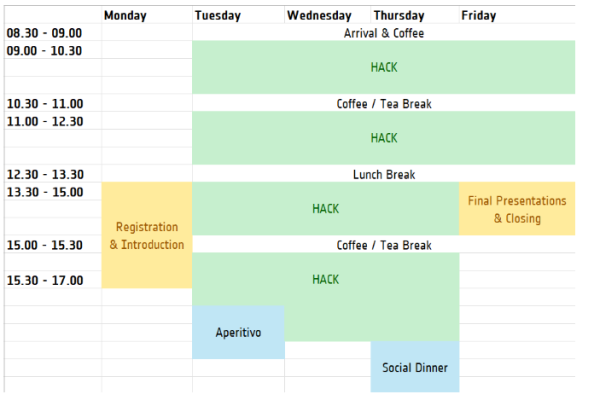
Participation
- A 5-day, in-person hackathon, 12–16 October 2026, at ESOC (ESA’s Mission Control Centre) in Darmstadt (near Frankfurt), Germany.
- It is open to Master, PhD and postgraduate researchers interested in the Biomass mission and its applications.
- Python familiarity is required for the hands-on coding work.
- Working language: English.
- No participation fee. Participation is limited to 35 attendees.
- To participate, please apply using the registration link below.
For this edition of the BIOMASS Hackathon, participation is limited to nationals of ESA’s Member States, Associate Members, European Cooperating States and Canada.
Registration
Registration deadline: Friday 31 July 2026 at 23:59 CEST.
Notifications of acceptance: early September 2026.