Published on 7 October 2026
El Niño may influence European summers more than previously thought. An analysis by EUMETSAT of more than three decades of satellite and climate observations shows that El Niño summers tend to be warmer, sunnier and drier across large parts of western and central Europe.
Researchers compared conditions during six El Niño summers since 1991 with both the long-term average and six La Niña summers. The clearest signal appears over western and central Europe, where El Niño years were associated with higher temperatures, more incoming solar radiation and reduced soil moisture and rainfall.
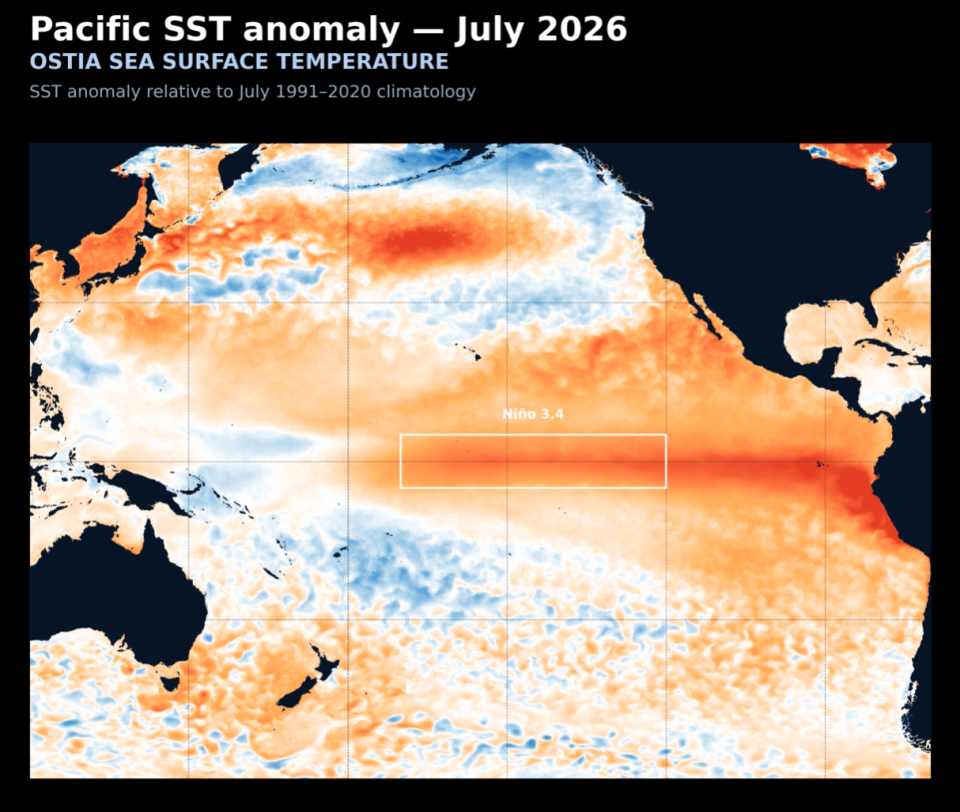
Summer 2026 brought exceptionally warm and dry conditions to large parts of Europe. EUMETSAT’s analysis suggests that the developing El Niño may have amplified some of these anomalies, particularly across western and central Europe.
Image: EUMETSAT
The connection is not uniform across the continent. While western and central Europe generally show warmer, sunnier and drier conditions during El Niño summers, parts of southeastern Europe and the eastern Mediterranean can display an opposite signal.
Satellite observations play an important role in revealing these patterns. The study combines long-term records of quantities such as soil moisture and surface solar radiation from EUMETSAT’s Satellite Application Facilities with other climate datasets, allowing researchers to compare several decades of changing European conditions.
Human-induced climate change remains the main driver behind Europe’s increasingly extreme summer temperatures. El Niño is an additional source of natural variability that can strengthen or weaken regional conditions from one year to another.
Based on: EUMETSAT, Satellite data link El Niño to hotter, sunnier, drier summers across Europe, 6 October 2026.