Publié le 26 septembre 2025
Monitoring global land cover and tropical forests is essential for addressing deforestation, biodiversity loss, and climate change. To support research, policy and decision making aligned with the United Nations Sustainable Development Goals, the Copernicus Land Monitoring Service (CLMS) initiated the Copernicus Land Cover and Tropical Forest Mapping and Monitoring (LCFM) service, which released its first global maps in June 2025.
Building on earlier initiatives like Copernicus Global Land Cover, ESA WorldCover, and REDDCopernicus, the LCFM service provides timely, open, and reliable data crucial for scientists, governments, and policy makers. These datasets are crucial to understanding our changing planet and guiding effective actions. Joris Coddé, one of the scientists behind the new LCFM products, explains more about the development, technical innovations, access and use of the land cover map at 10 m resolution.
Improved spatial detail and continuous annual updates
Launched in 2024 under the Copernicus Land Monitoring Service (CLMS), the Copernicus Land Cover and Tropical Forest Mapping and Monitoring (LCFM) service delivers a new suite of global land cover and pan-tropical forest monitoring products at 10 m resolution, updated annually to capture environmental change with unprecedented detail. After developing multiple data products for the 100 m Copernicus Global Land Cover, ESA WorldCover, and the REDDCopernicus projects, the LCFM service represents a major leap forward in both resolution and consistency. Its fine spatial detail of 10 m resolution enables precise plot-level monitoring on a global scale, while annual updates will ensure continuous tracking of global land cover and forest change.
In addition, the LCFM service will also resume the Copernicus Land Cover time series, providing new yearly updates from 2020 through 2026, and will introduce innovative sub-annual land cover products, capturing seasonal variations and enabling near real-time tracking of extreme events or land conversion. Together, these datasets form a consistent, long-term foundation for monitoring land use and deforestation worldwide
First products available via the CDSE
The LCFM service released its first products in June 2025 with the global Land Cover Map at 10 m (LCM-10) and the pan-tropical Tree Cover Density Map (TCD-10) for the year 2020. These products are open to all and freely available through the Copernicus Data Space Ecosystem (CDSE). Annual maps for 2021-2026 will follow, building a complete and consistent time series for global monitoring. Together, these products establish a robust and innovative baseline for global land cover mapping within the Copernicus Land Monitoring Service and available via CDSE.

The LCFM 10 m Global Land Cover Map (LCM-10) released in June 2025
© European Union's Copernicus Land Monitoring Service information; DOI.
- The Global Land Cover Map (LCM-10): The LCM-10 product delivers an annual global land cover map at 10 m resolution, comprising 11 thematic classes that represent major vegetation types, bare surfaces, built-up areas, permanent water bodies, and snow or ice. Updated each year, it supports a wide range of applications, including monitoring deforestation, assessing biodiversity change, and analyzing urban expansion and agricultural dynamics.
- The Pan-Tropical Tree Cover Density Map (TCD-10): The TCD-10 product provides information about tree cover density across the pan-tropical regions at 10 m resolution, offering a detailed view of canopy closure. Values are grouped into 10 classes, each representing a 10% range of tree cover density. Unlike categorical land cover maps, TCD-10 provides a quantitative measure of forest structure and quality. This makes it possible to track not just where forests are, but also how dense and resilient they are. Such insights are crucial for assessing carbon storage, biodiversity, and ecosystem health, and they directly support compliance with environmental frameworks such as the EU Deforestation Regulation (EUDR).
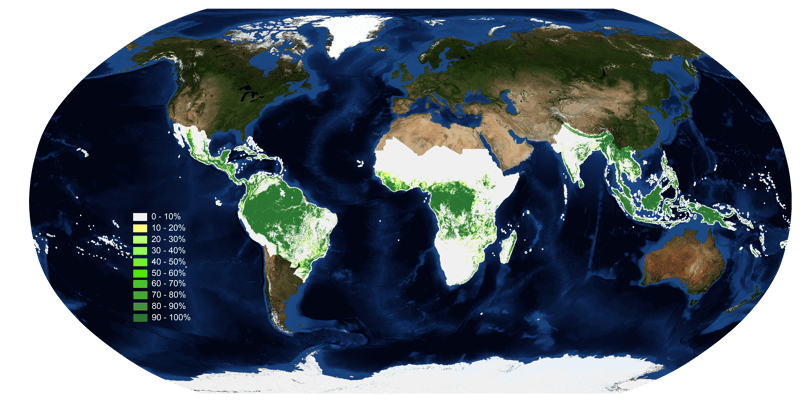
The LCFM 10 m Pan-Tropical Tree Cover Density Map (TCD-10) released in June 2025
© European Union's Copernicus Land Monitoring Service information; DOI.
The LCFM products are fully integrated into the Copernicus Data Space Ecosystem (CDSE) and can be accessed via the:
- Copernicus Browser: Access LCM-10 and TCD-10 to visualize, analyze, and download.
- S3 access for direct retrieval from the EODATA S3 bucket.
- OData API for programmatic queries and integration into workflows.
More details can be found on the CDSE documentation. Technical details and usage guidelines for the Copernicus LCFM products are provided in the LCM-10 and the TCD-10 Product User Manuals.
Source:
VITO Remote Sensing. (2025, September 25). High-Resolution Insights for Land Cover and Forestry Monitoring with Copernicus LCFM.