Publié le 22 octobre 2026
As Arctic permafrost thaws, carbon that has been locked in frozen ground for thousands of years can escape into the atmosphere as carbon dioxide and methane. But scientists still disagree sharply on how much methane the Arctic is actually releasing.
ESA’s AMPAC-Net initiative has brought European, American and Canadian researchers together to compare satellite observations, field measurements and models, with the aim of closing some of the biggest gaps in our understanding of Arctic methane emissions.
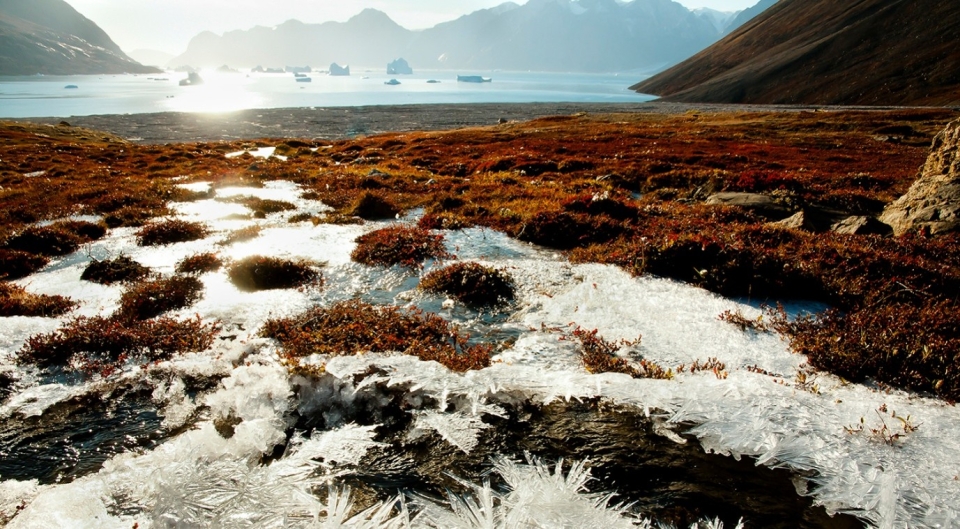
Thawing Arctic permafrost can release carbon as both carbon dioxide and methane. Satellite observations provide crucial large-scale measurements across this remote region, complementing field observations and atmospheric models.
Image: ESA
One striking result shows just how large the remaining uncertainty is. A recent synthesis estimated Arctic methane emissions at around 39 teragrams of methane-carbon per year using bottom-up approaches, compared with only about 15 teragrams from atmospheric inversions. Even the uncertainty ranges of the two estimates did not overlap.
Satellite data are an important part of efforts to reconcile these differences. AMPAC-Net has investigated, among other approaches, how methane observations from the Copernicus Sentinel-5P TROPOMI instrument can be combined with inverse modelling to better constrain Arctic emissions.
The network has also created a dedicated methane data catalogue containing dozens of datasets and supported collaboration on future missions, field measurements and modelling. The goal is to turn very different pieces of evidence into a more consistent picture of how a warming Arctic may affect the global carbon cycle.
Based on: ESA EO Science for Society, Arctic methane into focus: the AMPAC-Net community, 20 October 2026.