Reducing, and where possible removing, anthropogenic greenhouse gas emissions is one of the cornerstones of climate action and fundamental to reaching the goals set out in the Paris Agreement (COP 21).
This transition, and climate action in general, require substantial funds and investment. Carbon pricing and carbon credits were seen as a “win-win” mechanism to reduce emissions and generate the necessary funds to support climate action. With two main types of carbon markets, compliance and voluntary, a whole new ecosystem was born around carbon pricing and credits. But this rapid growth also brought issues regarding the quality and integrity of the credits being issued. Efforts have been made across the value chain to address these issues (e.g. the CRCF regulation at EU level).
In this context, Earth Observation can monitor land use, detect changes, and quantify carbon dynamics at scale, with strong potential to become a standard component of carbon farming MRV. This would ultimately support the quality and integrity of carbon projects and the credits they generate.
These concepts were explored in a paper put together within the context of the recently finished CREDIBLE project. The paper examines which actors are currently using EO for MRV of Carbon Farming across the value chain, how they are doing so, and what challenges or bottlenecks exist in the use of EO.
Join us for our first EOcafe after the summer break, as our host Monica Miguel-Lago (Senior Project Manager, EARSC Secretariat) will be joined by some of the key authors and contributors of this paper, Saheba Bhatnagar (Senior Remote Sensing Scientist, BeZero Carbon) and Mila Luleva (Strategic Transformation and Innovation Partner – Model Risk Management, Rabobank). Together, they will explore the workings of carbon markets and how the different actors are (or aren’t …) using EO-based information and services, with a specific focus on how EO can support the funding and assessment of carbon projects. Other co-authors/contributors of the paper and members of the EARSC Carbon Working Group will also be invited to share their thoughts during the EOcafe.
Some questions we could address during this EOCafe include:
- Who are the main actors in carbon markets (Voluntary and Compliance)?
- What is the role of banks/investment companies such as Rabobank? And what is the role of rating agencies, such as BeZero Carbon?
- Is EO currently being used by these different actors, and if so, how? And where not, why not?
- More specifically, in the context of banks and investment companies, what information do banks need to have before investing in a carbon project? And how could EO support this?
- Similarly, how are rating agencies using EO to certify projects? What would make EO-based information sufficiently reliable to use in this context?
- At EU-level, we now have the CRCF Regulation. How does/will this impact your organisations and the broader existing “carbon actors”? Are there any new opportunities for EO in this context?
- From the EO service or data provider point of view, where do you see the main opportunities? What are the challenges you still face in the adoption of EO-based information and services in this market? What would be needed from all the different actors to change the situation?
Registration
The webinar is open to all. Registration is free but compulsory.
Please note this is a virtual event!
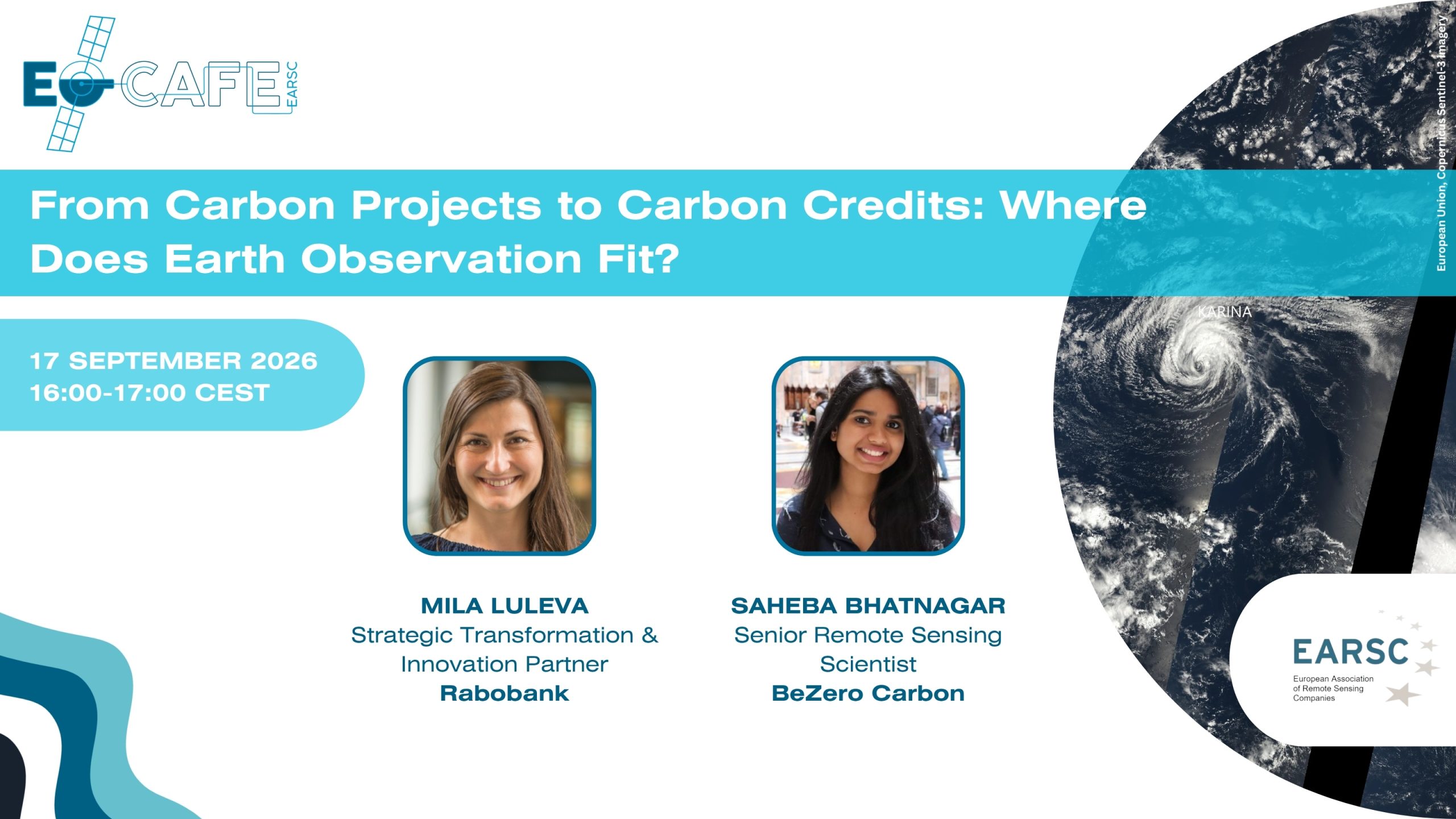
EOcafe is part of a series of EARSC meetings that offer timely, relevant, and practical information on a broad variety of topics related to the EO sector. Join us every month to discuss and network while enjoying a cup of coffee with friends.