Gepubliceerd 4 dagen ago
In the southern Namib Desert, a nearly perfect circular scar interrupts an otherwise endless landscape of orange and red dunes. The Roter Kamm crater was formed by a meteorite impact several million years ago and remains remarkably well preserved today.
About 2.5 kilometres wide, the crater lies inside Namibia’s TsauǁKhaeb National Park, roughly 10 kilometres south-west of the Aurus Mountains. Over time, wind-blown sand has accumulated inside the depression, while its raised rim still stands out clearly from the surrounding desert.
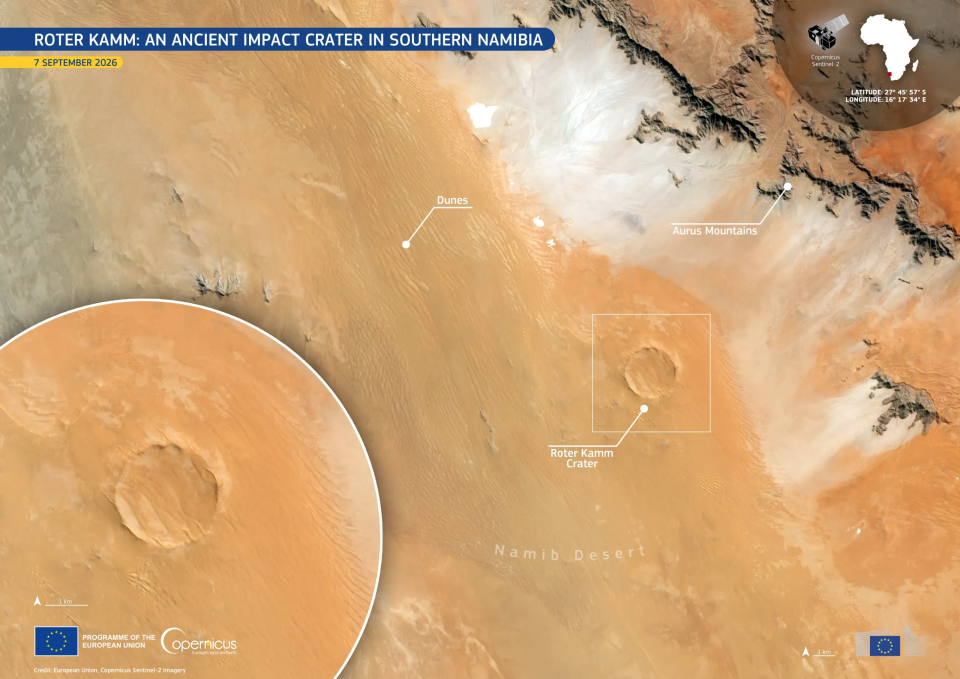
The 2.5-kilometre-wide Roter Kamm impact crater stands out among the orange and reddish dunes of southern Namibia. Wind-blown sand has gradually filled much of its interior, while the crater rim remains clearly visible from space.
Image: European Union, Copernicus Sentinel-2 imagery
Sentinel-2’s high-resolution optical imagery is particularly well suited to mapping landforms in remote desert regions, where geological structures can often be recognised more easily from above than from the ground.
Repeated observations also allow scientists to monitor how dunes, vegetation and other surface features evolve over time, making satellite imagery a valuable tool for studying both ancient geology and present-day landscape change.
Based on: EU Space, Roter Kamm: an ancient impact crater among the sand dunes of southern Namibia, 24 October 2026.