Gepubliceerd op 28 september 2026
Sea surface temperatures off the Belgian coast reached unprecedented levels this summer, making 2026 the warmest year in the record since at least 1980. According to researchers at the Royal Belgian Institute of Natural Sciences, the anomaly raises serious concerns about possible impacts on marine life in the Belgian part of the North Sea.
Scientists classify a marine heatwave when sea surface temperatures remain above the 90th percentile for at least five consecutive days. This summer, that threshold was exceeded for no fewer than 87 days in a row, from 16 June to 10 September.
For much of that period, temperatures were not only unusually high, but even above the historical maximum for the season. The event is therefore considered exceptional in both duration and intensity.
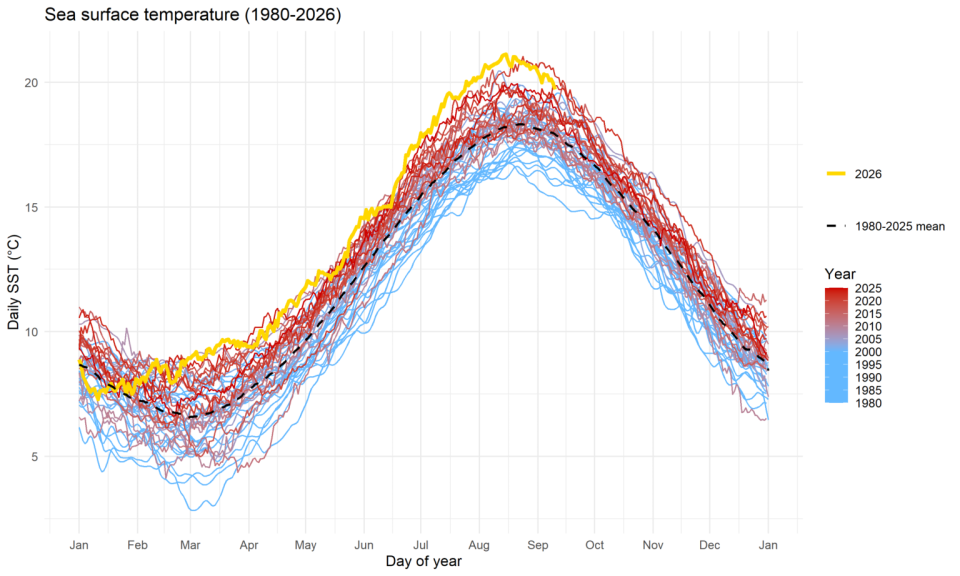
Sea surface temperatures at the Akkaert station in the Belgian Part of the North Sea reached record levels in summer 2026, far exceeding the threshold used to identify marine heatwaves.
Image: Institute of Natural Sciences, based on Copernicus data
Marine heatwaves can have far-reaching consequences for biodiversity. Warmer water affects metabolism and oxygen availability, increasing stress on marine organisms and potentially altering plankton communities, fish populations and the wider food web.
Researchers at the Royal Belgian Institute of Natural Sciences are monitoring these developments as part of their work on biodiversity in the Belgian Part of the North Sea. Through the RECAP and CodeBlue projects, the ECOMOD modelling team is also producing long-term forecasts to better understand how climate change and eutrophication may shape future marine conditions.
This summer’s event underlines how important sustained Earth observation and ecological monitoring are for understanding rapid environmental change in Belgian waters.
Based on: Institute of Natural Sciences / OD Nature, This summer, sea surface temperatures off the Belgian coast have been the highest recorded since at least 1980.