Gepubliceerd op 28 september 2026
Europe’s first geostationary air-quality mission has reached another major milestone. Following its commissioning phase, responsibility for operating Copernicus Sentinel-4 is moving to EUMETSAT, paving the way for routine hourly observations of air pollution over Europe.
Sentinel-4 flies aboard the Meteosat Third Generation Sounder 1 satellite, or MTG-S1, in geostationary orbit some 36,000 km above Earth. From this fixed vantage point, its ultraviolet, visible and near-infrared spectrometer can repeatedly scan Europe and parts of North Africa throughout the day.
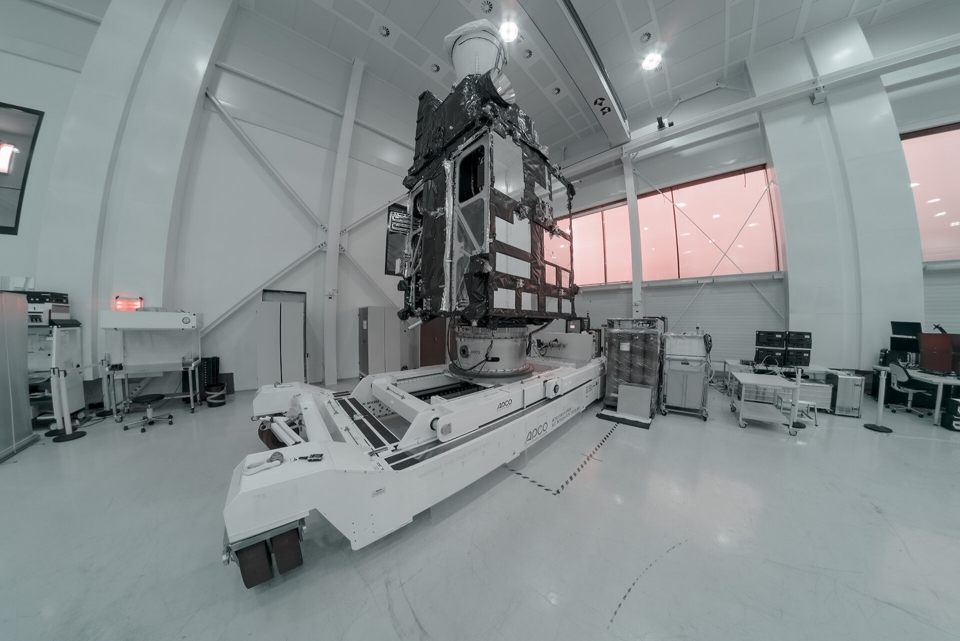
The Copernicus Sentinel-4 spectrometer mounted on the Meteosat Third Generation Sounder satellite. From geostationary orbit, the instrument will monitor atmospheric composition over Europe every hour during daylight.
Image: ESA/Mlabspace
Unlike earlier atmospheric Sentinel missions in low Earth orbit, Sentinel-4 can observe the same region again and again during the course of a single day. This makes it possible to follow how pollution evolves from morning to evening, including changes linked to traffic, industry, weather and natural events such as volcanic eruptions.
EUMETSAT will operate the instrument and process and distribute its data as part of its wider role in the Copernicus programme. Combined with observations from MTG-S1’s Infrared Sounder and other Meteosat instruments, Sentinel-4 will provide a much more detailed picture of both the state and composition of Europe’s atmosphere.
Based on: EUMETSAT, EUMETSAT takes charge of Copernicus Sentinel-4.