Published on 15 September 2026
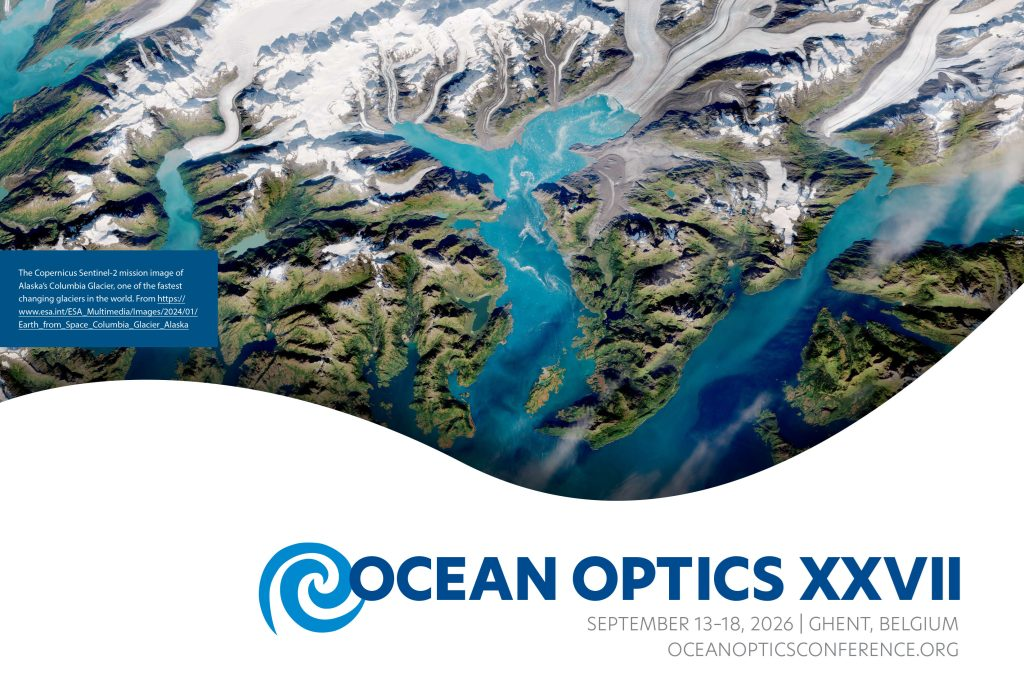
From 13 to 18 September 2026, Ghent became the centre of the international ocean-colour community as Ocean Optics XXVII brought together more than 350 scientists, engineers, students and Earth observation experts from 29 countries.
Ocean Optics is the leading international conference on the optics of inland, coastal and ocean waters. For the Earth observation community, this means much more than studying how light travels through water. Ocean optics provides the physical basis for turning measurements made by satellite sensors into information on phytoplankton, chlorophyll, suspended matter, water quality, carbon cycling and changing aquatic ecosystems.
The conference therefore sits at the interface between satellite observations, in-situ measurements, optical instruments and algorithms. Topics range from radiative transfer and phytoplankton ecology to new observation technologies, hyperspectral remote sensing and applications of data from current and future satellite missions.
Belgian expertise in the spotlight
Organised by the Marine Optics and Remote Sensing (MarSens) research group of Ghent University, with Griet Neukermans as Conference Chair, Ocean Optics XXVII offered a unique opportunity to bring the international ocean-optics community to Belgium and to showcase the expertise of Belgian research teams.
Researchers from Ghent University, the University of Liège, the Royal Belgian Institute of Natural Sciences (RBINS), VITO and VLIZ, among others, featured prominently throughout the scientific programme.
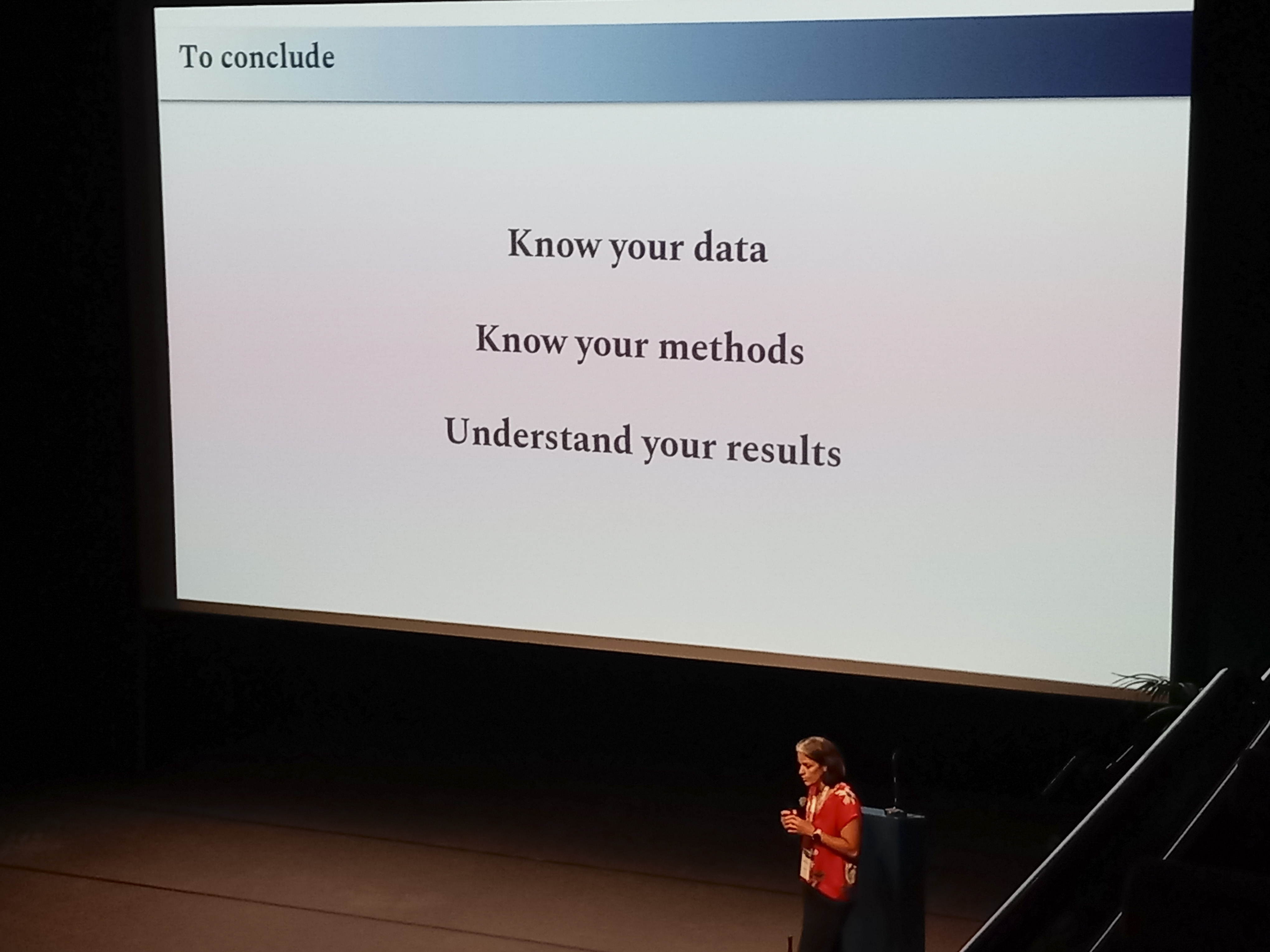
One of the highlights was a keynote presentation by Dr Aida Alvera-Azcárate of the University of Liège, who addressed the challenge of interpolating sparse ocean-colour observations.
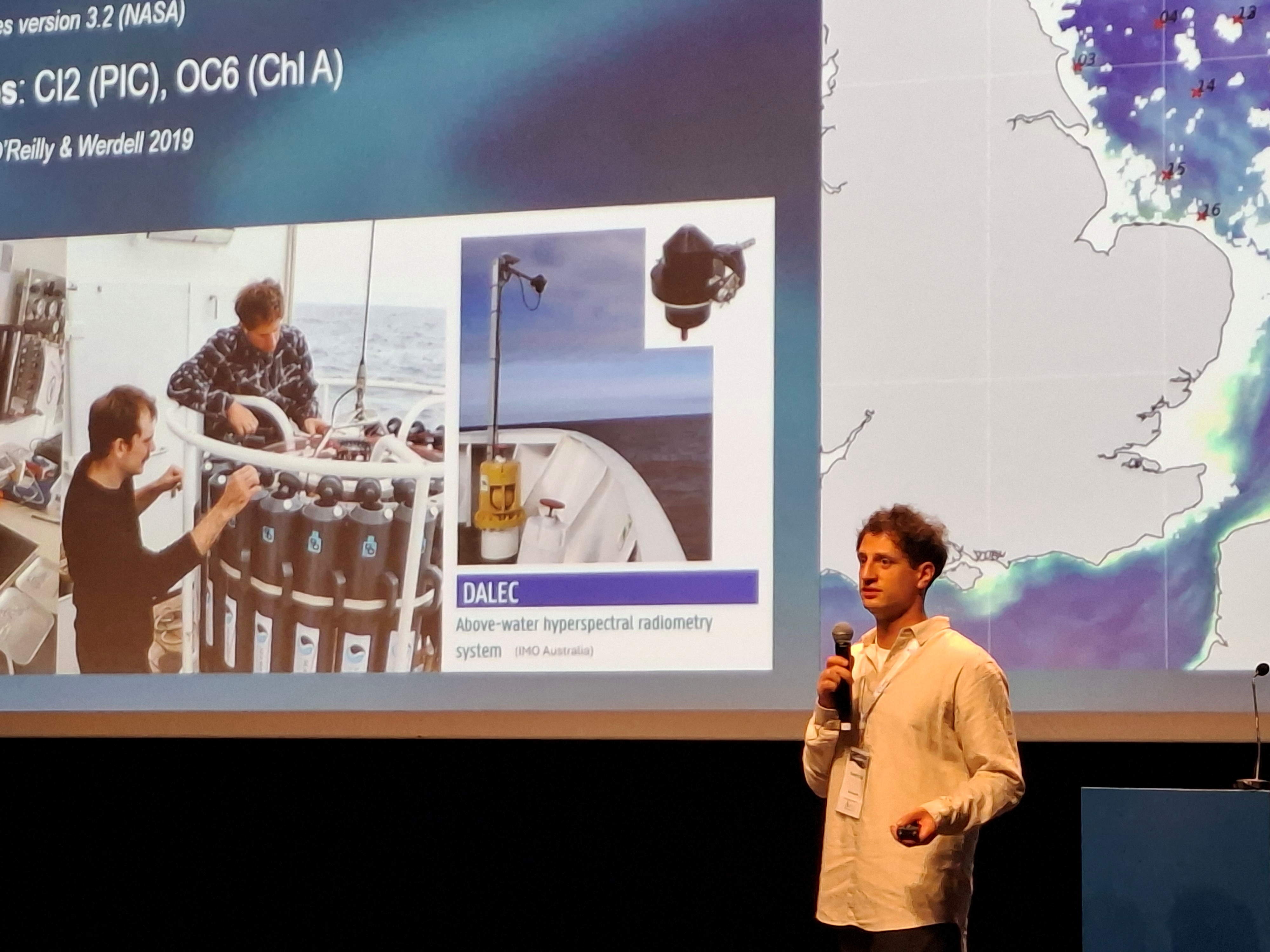
STEREO-funded research was also directly represented in the programme. Timotheus Fügl presented work carried out within the ROCOCO project on mapping particulate inorganic carbon (PIC) using observations from NASA's PACE mission.
The Management of the Marine Environment unit of RBINS contributed several oral and poster presentations. Among them was work on AQUASCOPE, developed by RBINS and VITO as an aquatic Earth observation service for users of the Belgian North Sea.
AQUASCOPE combines observations from Sentinel-2 and Sentinel-3 to provide information on parameters such as chlorophyll-a, turbidity, suspended matter, algal blooms and sea-surface temperature.
Other Belgian contributions covered a broad spectrum of aquatic Earth observation, including Sentinel-3/OLCI, hyperspectral satellite observations, UAV measurements, atmospheric correction and the potential of the Meteosat Third Generation Flexible Combined Imager to observe marine processes in the North Sea.
A community across generations
Ocean Optics is not only a major scientific conference, but also a remarkably close-knit international community. PhD students and early-career researchers play a prominent role and have ample opportunity to interact directly with well-established scientists in the field.
Dedicated networking events and short courses reinforce that exchange between generations. On Sunday alone, 95 participants took part in specialised courses and workshops.
Interest in presenting new research was exceptionally high. Of around 270 submissions requesting an oral presentation, only 51 could be selected. Posters therefore formed an equally important part of the scientific exchange, with 256 poster presentations throughout the week.
This combination of an open scientific community and a deliberately multidisciplinary programme brings together oceanographers, limnologists, marine ecologists, optical engineers, Earth observation scientists, technology developers and data specialists. It creates an environment in which new observation techniques can develop from experimental measurements into mature EO products and applications.
BELSPO supporting aquatic Earth observation
BELSPO, through the STEREO programme, is proud to support Ocean Optics XXVII as a conference sponsor, alongside Belgian partners such as FNRS, FWO and VLIZ, and international organisations including NASA, ESA, EUMETSAT and Copernicus.
Bringing a conference of this scale to Belgium strengthens the international visibility of Belgian research teams, creates new opportunities for collaboration and allows young Belgian scientists to engage directly with some of the leading experts in aquatic Earth observation.
From instruments in the water to sensors hundreds of kilometres above Earth, Ocean Optics XXVII demonstrated how understanding the interaction between light and water ultimately enables us to observe our oceans, coasts and inland waters from space.