

I - WHAT CAN WE OBSERVE AND HOW?
1- ELECTROMAGNETIC RADIATION
Light is a form of radiation: energy that moves as electromagnetic (EM) waves. We can describe these energetic waves based on:
- the wavelength (λ), expressed in metres;
- the frequency (ν), i.e. the number of oscillations per unit of time, expressed in hertz;
- the energy (E), represented by the amplitude of the wave, expressed in electron volts.

An electromagnetic wave is characterised by its wavelength (distance between two consecutive peaks), its frequency (number of cycles per second) and its amplitude (signal strength). Source of original image: Quizlet.com.
These three variables used to describe EM radiation have an exact mathematical relationship. For example, λ and ν are inversely proportional and related to the speed at which the waves propagate in a given medium. In a vacuum, this is the speed of light (c).
λ.ν=c
The energy contained in a wave is directly related to its frequency according to Planck's constant (h):
E=h.ν
h = 6,626×10-34 J.s
Longer waves have a lower frequency and are therefore less energetic than shorter waves, which have a higher frequency. You can intuitively visualise this by imagining a skipping rope that someone is moving up and down at each end. It will take you more effort (and therefore more energy) to get more waves in the rope.

Representation of a simple harmonic motion (sine wave). Source: Wikimedia Commons
But why then do we use three different variables (λ, ν, E), each with their own physical unit, to describe the same wave? It has everything to do with the application.
There are many different types of radiation. Scientists choose the units that are easiest to use for the type of radiation they are studying. If you want to indicate the distance to the bakery, you use kilometres or metres, not centimetres or millimetres. For example, radio astronomers will often talk about frequencies (GHz, kHz), while remote sensing specialists will talk about wavelengths (micrometres -µm or 10-6 m- or nanometres -nm or 10-9 m), while astronomers studying gamma rays will tend to use electron volts.

The electromagnetic spectrum. Source: Electromagnetic Waves & Electromagnetic Spectrum, Mini Physics, modified by RMI.
What different types of electromagnetic radiation are there and which part of that broad spectrum is important for remote sensing?
The entire range of radiation according to wavelength, frequency or energy is called the “electromagnetic spectrum”.
For us humans, a small part of this spectrum is particularly important for our daily perception: visible light, with a wavelength varying between 0.4 μm and 0.7 μm. Our eyes interpret these different wavelengths as colours, ranging from blue (± 0.45 μm) to green (± 0.55 μm) to red (± 0.65 μm).
If we divide the rest of the spectrum according to wavelength, we can distinguish other areas. Short waves, such as gamma rays and X-rays (< 0.03 μm), are the most energetic. Radio waves are relatively very long (> 1 m) and therefore transmit less energy. For earth observation, visible light and certain parts of the infrared and microwave ranges are mainly used.
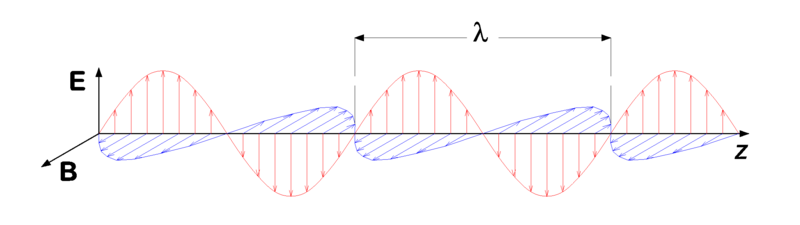
Vertically polarised electromagnetic wave: the electric field (in red) and the magnetic field (in blue) are at right angles to each other and perpendicular to the direction of propagation.- Source: Wikimedia Commons
In addition to wavelength or frequency, there is another characteristic: polarisation. Polarisation is the plane in which the wave propagates. In other words, this is the plane in which the sinusoid depicted above is drawn. We speak of linear polarisation when this plane is fixed along the propagation direction of the wave. If this plane changes during propagation, we are dealing with circular or elliptical polarisation.