

IV - FROM DATA TO INFORMATION
4- HOW CAN WE ANALYSE IMAGES AND PRODUCE MAPS?
4.1- How can we measure terrain height?
An important application of remote sensing is the creation of digital elevation models, files representing the height of terrain. Such models can be made in several ways: by using photogrammetric techniques applied to stereoscopic aerial photographs or satellite images, by LiDAR point clouds or by radar interferometry.
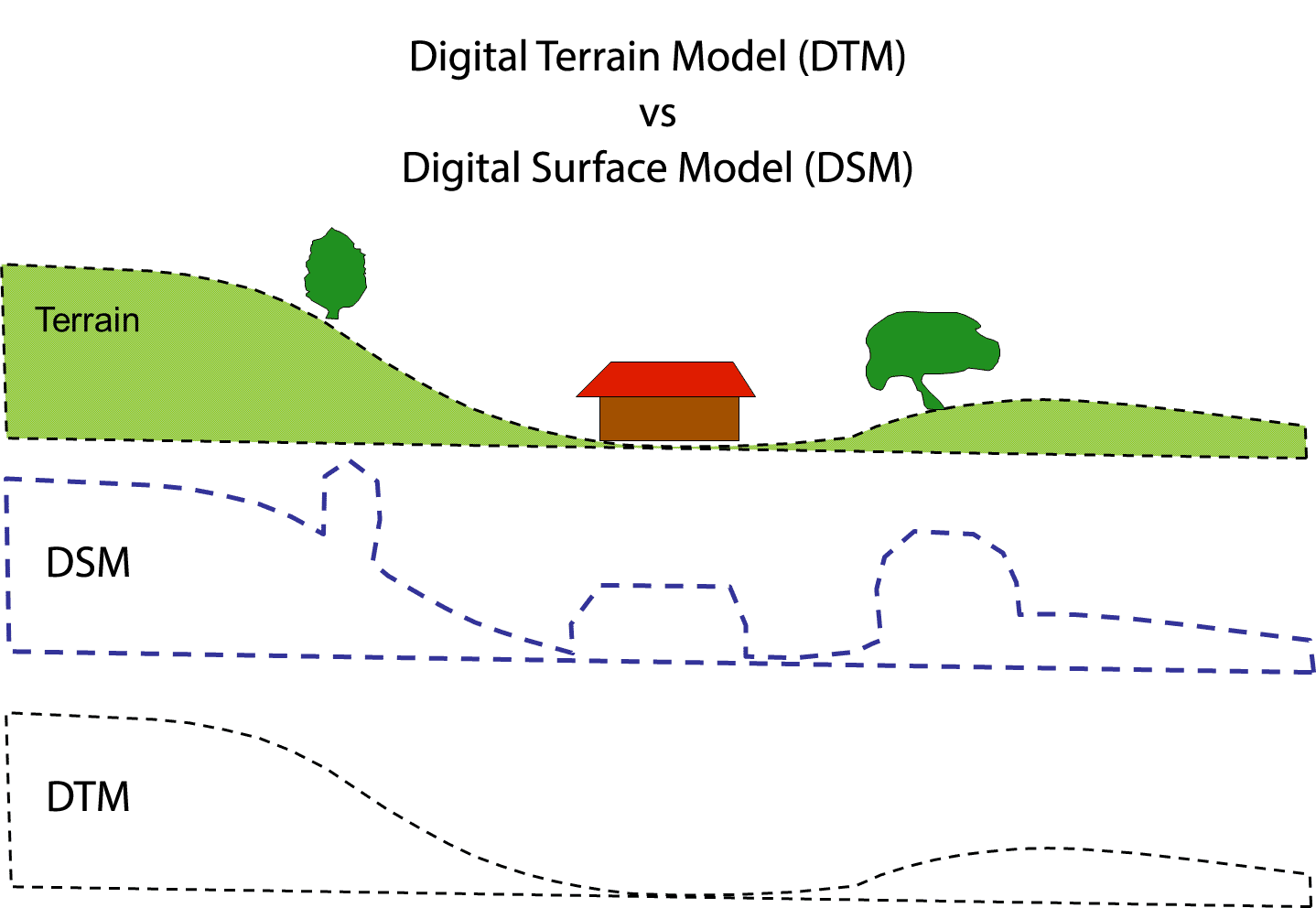 Digital Terrain Model (DTM) vs Digital Surface Model (DSM) in the presence of trees and buildings. Source: Master Géographies Numériques - Université Jean Monnet Saint-Etienne
We can either model the height of the bare ground surface or the height of the ground surface including everything on top of it (trees, buildings and all other natural or artificial objects). We call the former Digital Terrain Models (DTM), the latter Digital Surface Models (DSM). We can then consider the term "Digital Elevation Model" (DEM) as a generic term, but in most cases it is used as a synonym for DTM.
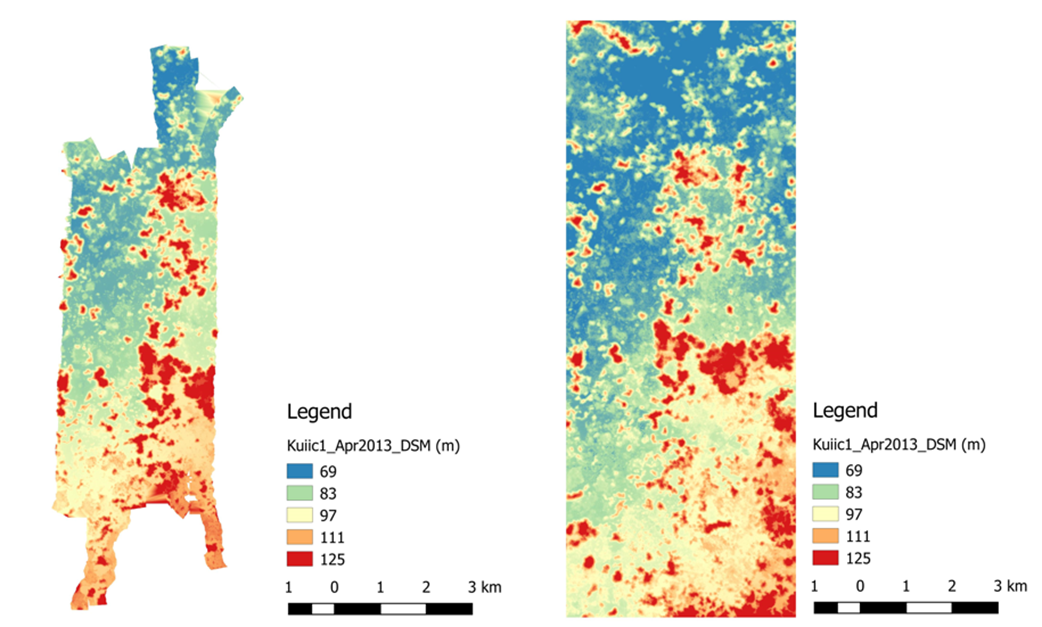
Digital surface models derived from LiDAR point clouds recorded from an aircraft (left) and based on stereoscopic Pléiades satellite images (right). Both are grid files with each cell representing the elevation (in metres above sea level) of the surface including the objects located on it. In this case, the lidar point cloud is less area-covering that the satellite image (location: Kiuic, Yucatan, Mexico). Realised as part of the STEREO III LIMAMAL project (see The lost world of the Maya revealed by satellites).
There are three types of remote sensing data that we can use to create digital elevation models: stereoscopic images, airborne laser scanning data and RADAR interferometry data.
Stereoscopic satellite images
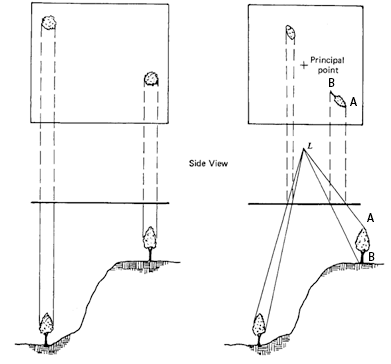
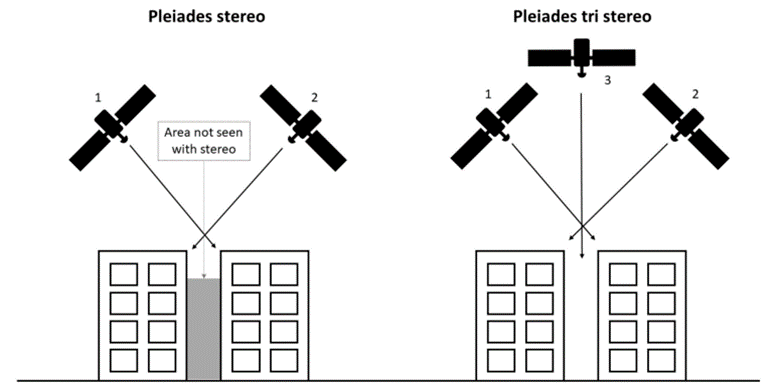
Stereoscopic satellite images or aerial photographs are shots taken of the same area from different angles. Objects of a certain height (buildings, trees,...) located in the overlapping parts of the images appear to change direction in one image relative to the other.
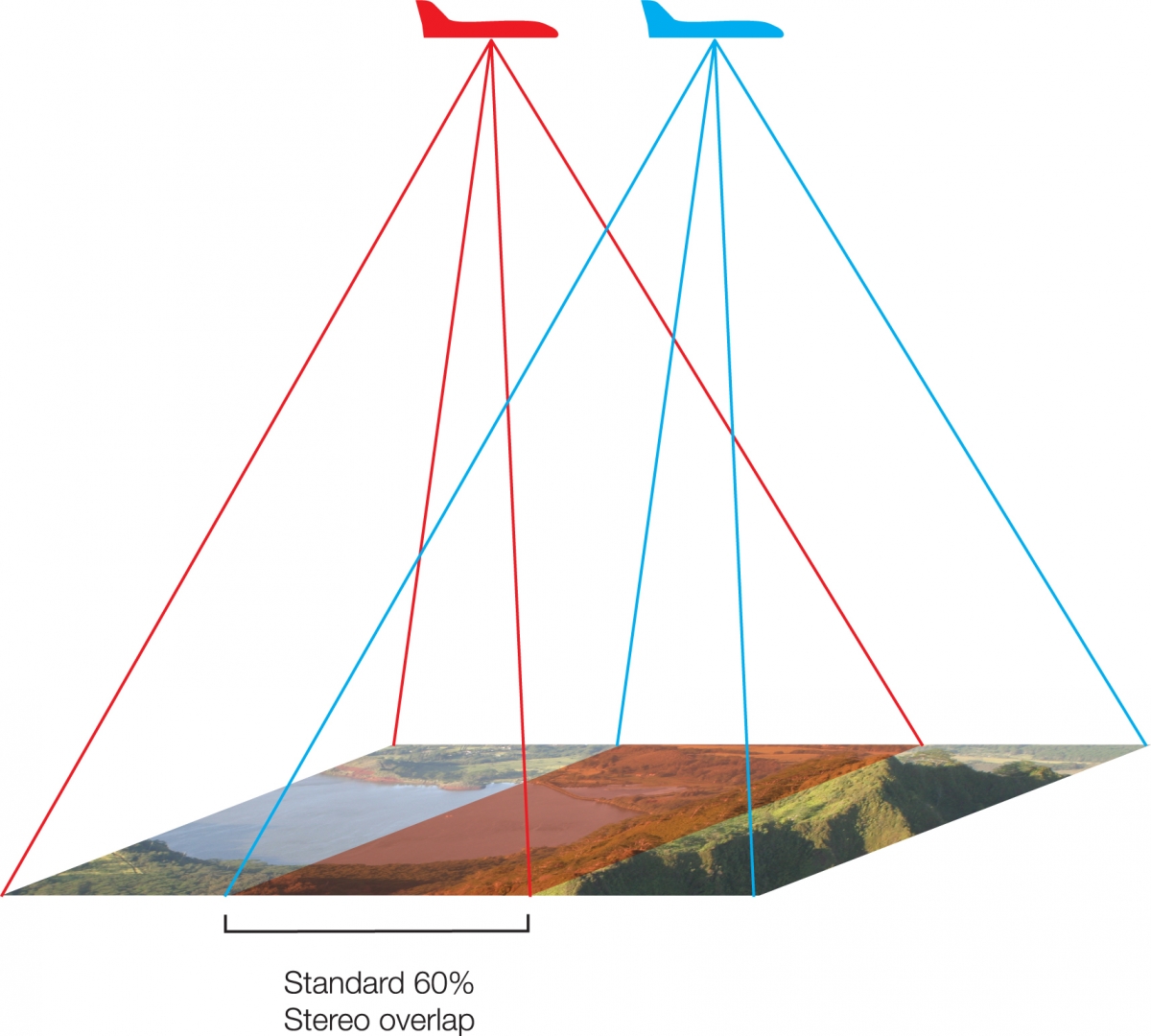
Stereoscopic aerial images are captured by planning the flight lines so that there is an overlap between two consecutive shots (red area on the figure). Such images are called a stereo pair. © Commonwealth of Australia - Intergovernmental Committee on Surveying and Mapping - Fundamentals of Mapping.
This apparent displacement or parallax occurs because of differences in viewing direction. Because of perspective, the top of objects on an image will always shift with respect to their base. We can connect the top and base of the object with a line on each image of the stereo pair and thus measure the parallax. With the right formulas and some reference points, we can calculate the height of the objects based on the parallax.
|
|
Now that we know how to calculate the height of one particular point on stereoscopic images, we can create a digital height model. For this, we look for objects or particular spots in the overlapping area of both images that we can identify separately on each image.
These tie points (yellow crosses on the aerial photograph) can be determined visually but fortunately there is software nowadays that can quickly determine a large number of these points for us. The software then automatically calculates the coordinates in three dimensions (x,y,z). From this "cloud of points" we can interpolate values to a grid from which we can finally create a digital grid image that can be used in a geographical information system.
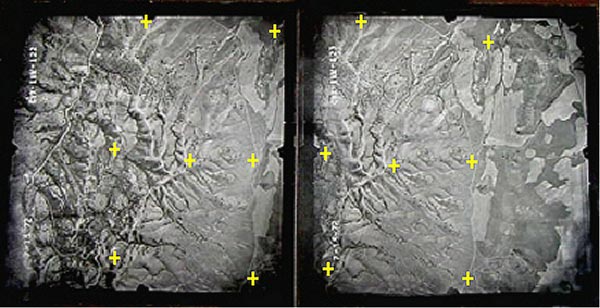
Source: Photogrammetry Methods at the Utah Geological Survey: From Field Mapping to Published Map
Airborne laser scanning
Another way to obtain a 3D point cloud is by airborne laser scanning (see Display of lidar data). This usually involves the use of a pulse-based laser scanner brought aboard an aircraft in combination with accurate devices that determine the position and orientation of the aircraft.
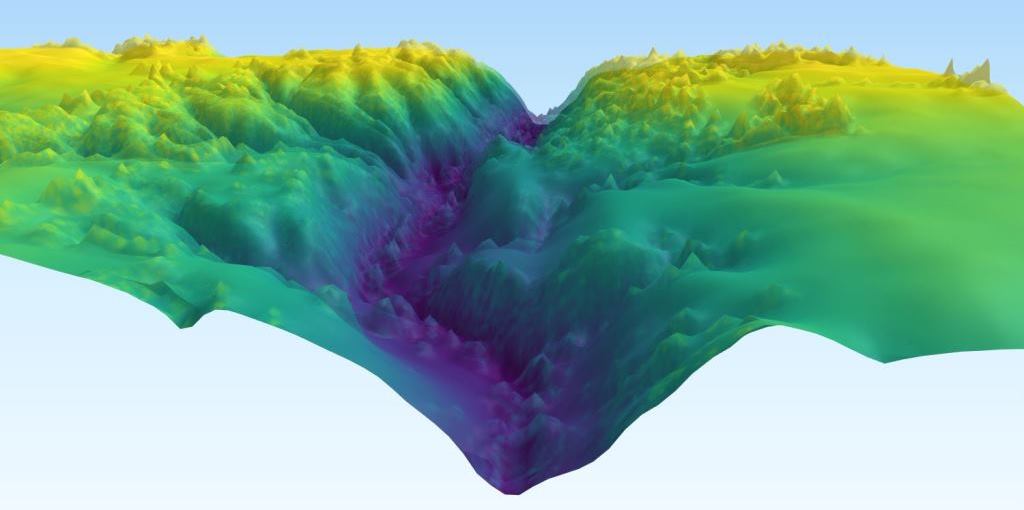
Perspective view of a digital surface model of a forested river valley in central Iowa, US, derived from LiDAR data. Source : Lidar-derived digital surface and elevation models of a stream channel (USGS)
The light pulses (often infrared) emitted by the laser scanner bounce off the terrain and are detected back by a receiver. Highly accurate electronics measure the time the pulses take to do so. The distance from the scanner to the object can then be easily calculated by multiplying the measured time by the speed of light and dividing the result by 2 (after all, the pulse goes back and forth).
To give you an idea: it takes light about 3.3 picoseconds (3.3 x 10⁻¹² sec) to travel 1 mm. The scanner features a rapidly rotating mirror that can reflect a dense point network of laser beams onto the terrain as the aircraft continues to fly. This creates a 3D point cloud consisting of millions of points that can be processed into a highly detailed digital elevation model.
Radar interferometry
Finally, we can also derive elevation models by using radar interferometry. Radar sensors are active sensors, i.e., like LiDAR itself, they emit a light wave that is partially reflected by the terrain and then recaptured by a receiver (see Radar images). Radar or SAR (Synthetic Aperture Radar) signals are characterised by an amplitude (the strength of the signal) and a phase (the fraction of a single SAR wavelength), which is mainly determined by the distance between the sensor and objects on the ground. Unlike with LiDAR, with a SAR signal we cannot determine the distance to the terrain based on the elapsed time. However, if we have two or more SAR recordings of the same area, taken from slightly different sensor positions (the so-called baseline), we can determine changes in altitude from the phase differences.
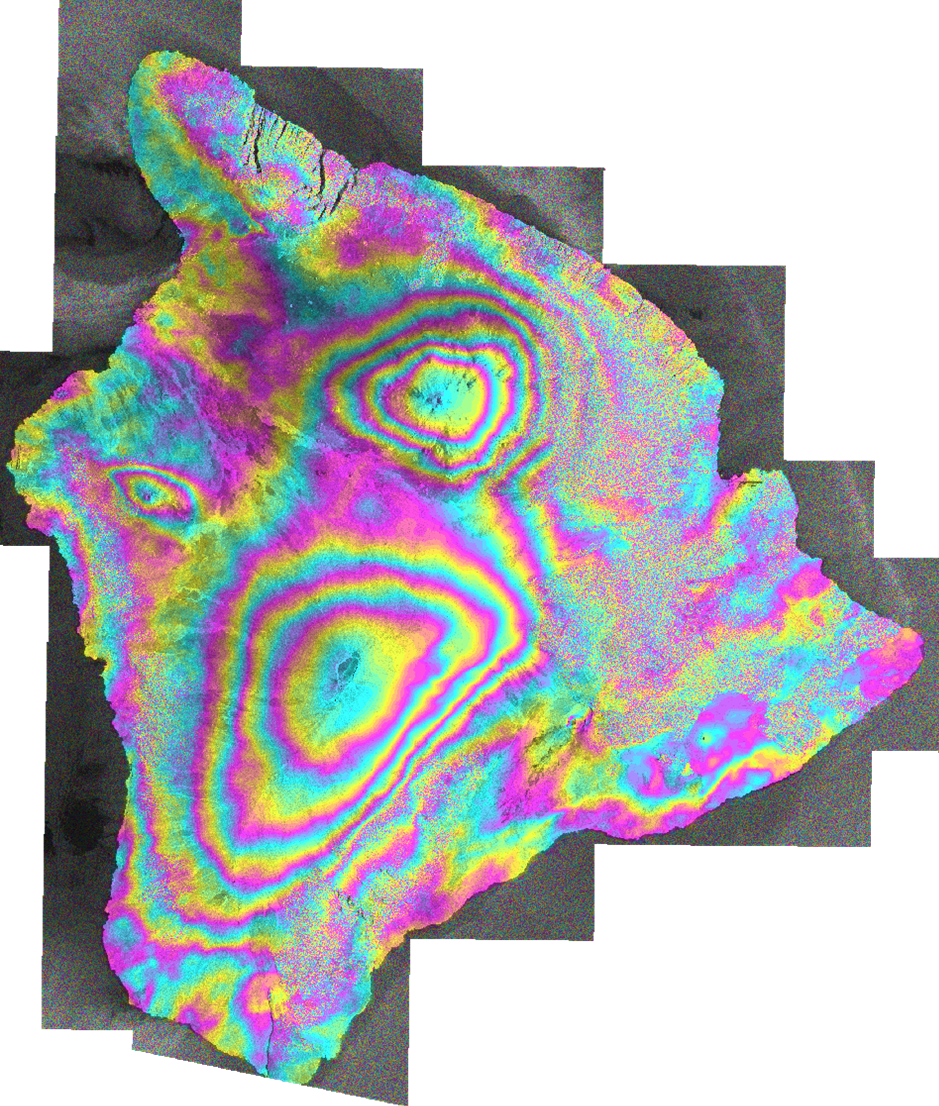
On this interferogram of Hawai (Kilauea) based on two Sentinel 1 SAR images recorded on 26/11/2020 and 2/12/2020, the fringes show that there was volcanic activity between the images. Between two rings of the same colour, there is a change in terrain height of 3cm.
The two SAR images forming the so-called interferometric pair could be recorded simultaneously from two sensors located at a certain distance from each other but equally by two successive recordings from a slightly different position. In both cases, a spatial image or interferogram is made of the phase differences, which are made visible as fringes in the order of the colours of the rainbow. A full phase corresponds to a full wavelength (e.g. 6cm for Sentinel-1), to be divided by two because the signal goes back and forth. If changes in the height of the terrain have happened between two consecutive shots (e.g. ground subsidence) then these can also be observed.
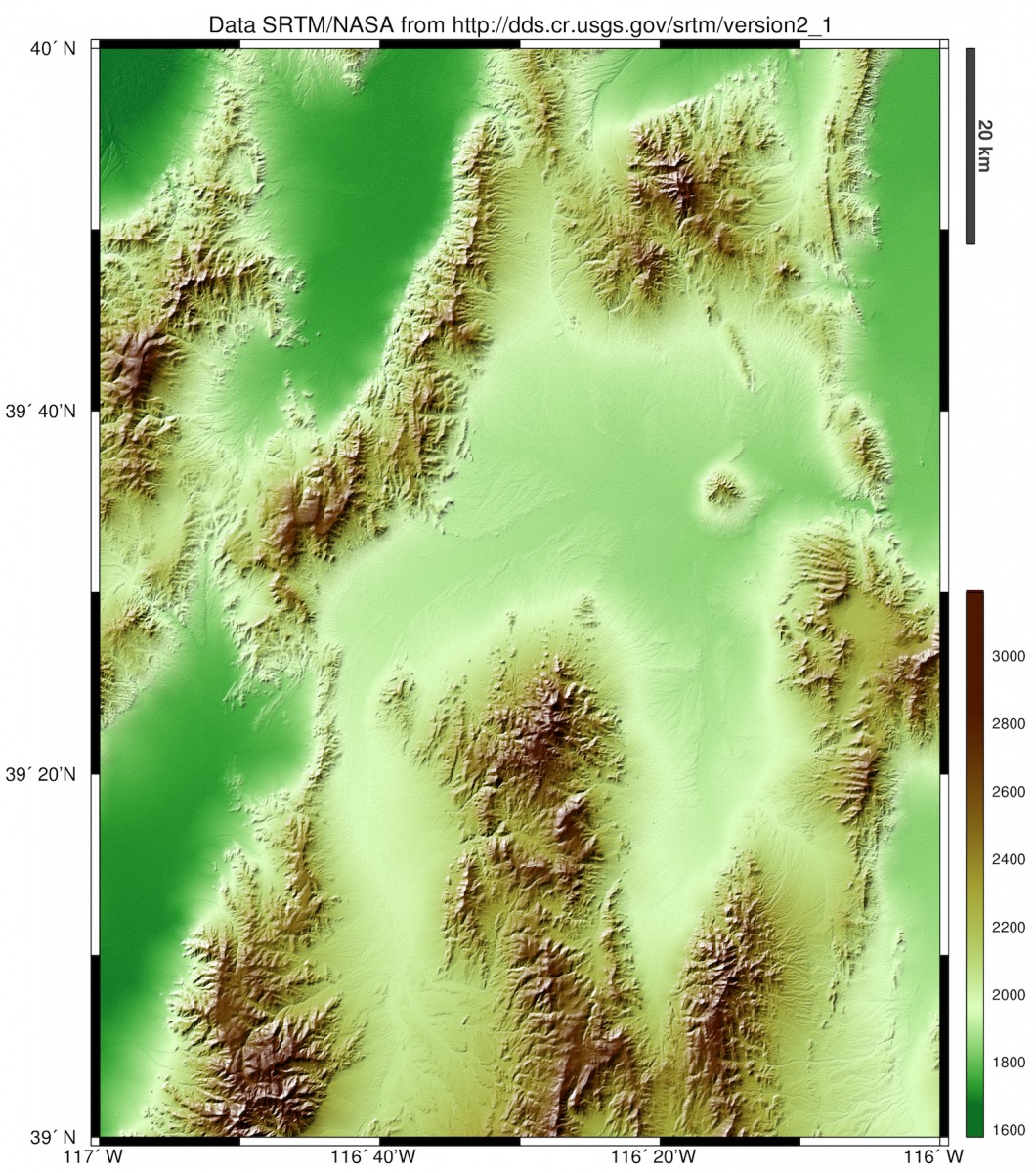
This digital elevation model was created by the Shuttle Radar Topography Mission. This radar system consisted of two antennas spaced apart on board the space shuttle Endeavour. Its purpose was to create a digital elevation model of a large part of the Earth.. Source: Example of relief map from SRTM1 data (central Nevada, near US-50) - Wikimedia Commons.