

III - WHAT IS A DIGITAL IMAGE?
2- CHARACTERISTICS OF AN IMAGE
2.4- Radiometric resolution
Radiometric resolution refers to the value range of a spectral channel: the possible number of values into which the recorded radiation can be divided. The better the radiometric resolution, the finer differences in light intensity or reflectance we can discern.
Digital data from sensors are encoded according to a number of bits. 1 bit contains only two possible values: 0 or 1. A sequence of 8 bits forms a byte. Each pixel of an image encoded in 8 bits can thus take 28 (256) different numeric values. Thus, on such an image, the brightness for each pixel can vary between 0 (black) and 255 (white).
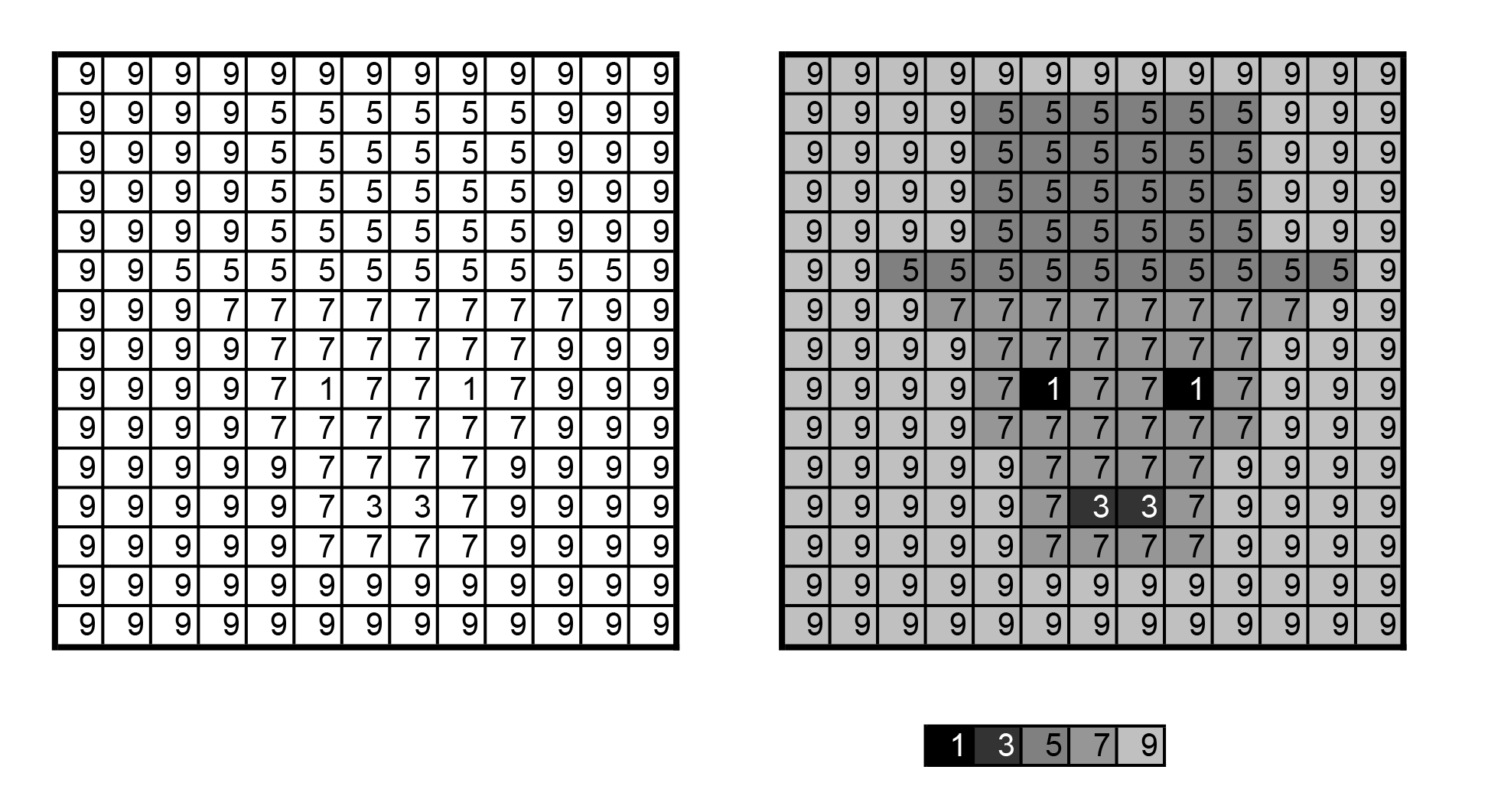
However, images are encoded according to an increasingly fine radiometric resolution. For example, Sentinel-2's MSI instrument has a radiometric resolution of 12 bits, theoretically giving a range of 0 to 4,095 212) possible light intensity values (greyscale values). For Landsat-8, this is even 16 bits, corresponding to 65,536 (216) different greyscale values.
However, radiometric resolution also depends on the signal-to-noise ratio of the detectors. Increasing radiometric resolutions make it possible to reproduce ever finer variations in brightness, making images increasingly detailed.
 |
 |
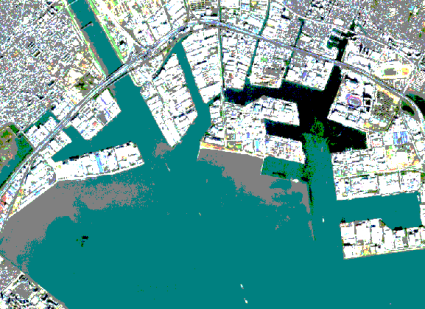 |
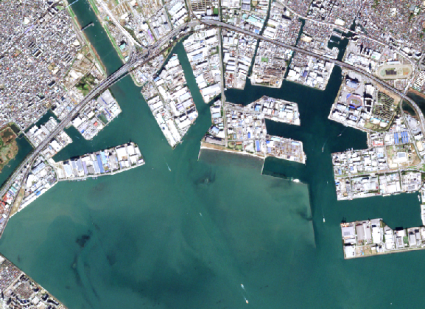
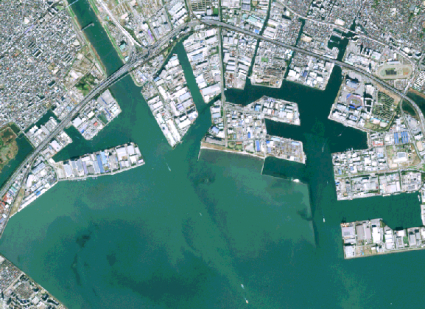
Source: What is Bit Depth for Satellite Data (and Images) - GISGeography
The above example shows the Tokyo coastline in three different radiometric resolutions (bit depths). In the image on the left, each band (red, green and blue) has a radiometric resolution of 8 bits and therefore 256 (28) shades. The middle image is encoded in 4 bits and therefore offers only 16 (24) shades. The image on the right, encoded in 2 bits, with only 4 colours per band, is clearly of mediocre quality.
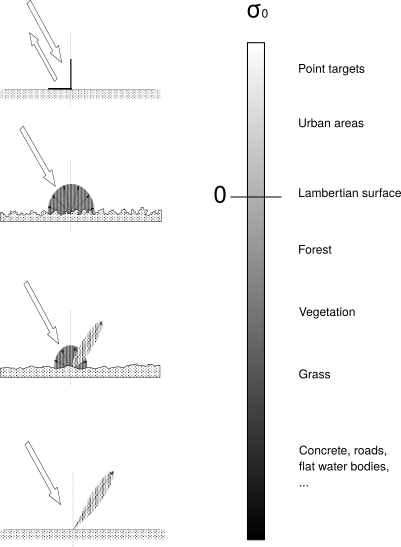
Since in radar images we can control the transmitted energy very precisely, we calculate the "grey level" of a pixel as the ratio between the energy received per unit area and the energy reflected from the area of the pixel and detected by the antenna. This is called the backscatter coefficient σ0, which is expressed in decibels (dB).
A value of 0 dB corresponds to an isotropic surface. Values greater than 0 usually correspond to urban areas or slopes facing the satellite and re-emitting the entire signal in that direction. Negative values correspond to various types of vegetation cover or reflective surfaces that do not reflect anything back to the sensor.
 |