

VI - INTEGRATION WITH OTHER DATA
The data derived from remote sensing is stored in Geographic Information Systems (GIS), which not only allow it to be processed and analysed, but also to be combined with other geographic data to create new maps. In addition, remote sensing data is often incorporated into various models to better understand and predict changes in the environment.
1 - GEOGRAPHICAL INFORMATION SYSTEM (GIS)
A geographical information system (GIS) is a computer system consisting of hardware, software and associated procedures that is used to store, manage, edit, display and analyse geographical data. It can therefore also be used to process data and maps derived from remote sensing data.
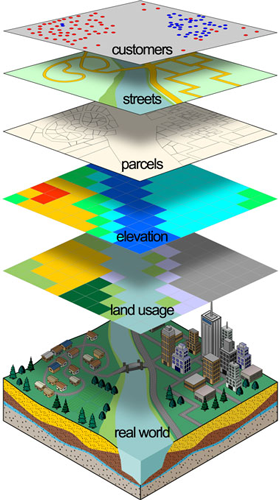
In a GIS, geographical information is provided in the form of layers that can be superimposed to combine different data. In principle, there are two types of data that can be processed in a GIS: vector data and raster data.
Vector data includes points, lines and polygons that are defined in space by corresponding coordinates. Each vector element is also accompanied by a list of data in which additional information is stored in the form of attributes. For example, we can link a closed polygon representing a building to attributes such as the address, the height of the building, the number of residents or the occupancy rate, the function of the building, the name of the owner or any other data deemed useful.
 |
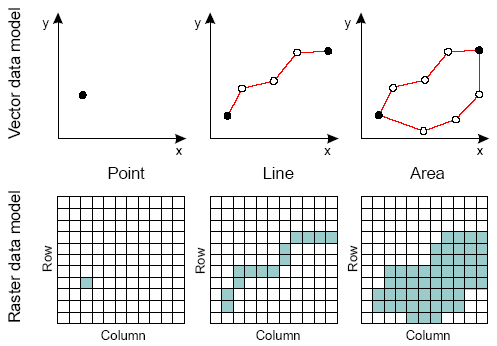 |
Grid data is data composed of separate adjacent cells or image elements (pixels) in a grid pattern, each containing a unique piece of information. This could be the height of the area covered by the pixel, a binary value regarding the presence or absence of an animal or plant species, a number between e.g. 1 and 10 representing a certain soil cover class, etc.
What is important is that this ‘image’ also has a cartographic context, i.e. it has coordinates and can be localised in space. It is therefore possible to combine vector and raster data and perform calculations based on their geometry, attributes or topology.
A GIS is therefore a ‘hybrid’ database with geographical data and associated attribute information that can be structured in thematic layers and continuously updated. That is why it is a valuable tool for governments, companies and research institutions. Thanks to the spatial analysis possibilities of the GIS, users can query the database based on a series of criteria, such as for example ‘Determine who lives in a 50-metre zone around that parcel of land’. The system then provides the operator with a list of the residents who meet that condition. That list can then be used for all kinds of administrative purposes.
Another very important aspect is that the answer to a question posed to the information system is not only given in the form of lists or tables, but that the system can also display the result in the form of a map, either on screen or on paper. Remote sensing images are therefore often used in combination with geographic data collected in a particular area to create new information in the form of maps.
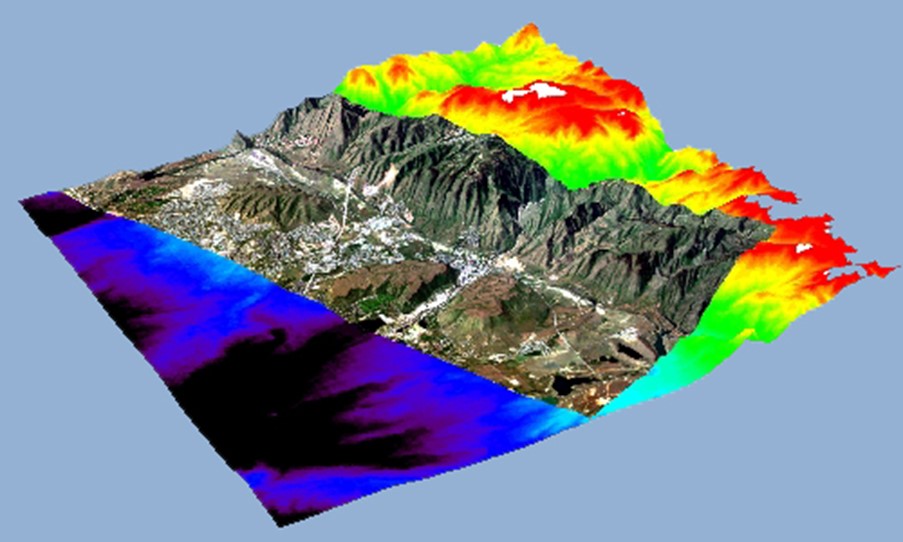
The combination of satellite images with a digital elevation model is used, for example, in the classification and mapping of forests in mountainous areas, where topographic factors determine, among other things, the type of vegetation at a particular location. Thanks to the elevation model, it is possible to distinguish between vegetation types with the same spectral properties.
More information about elevation models can be found here.
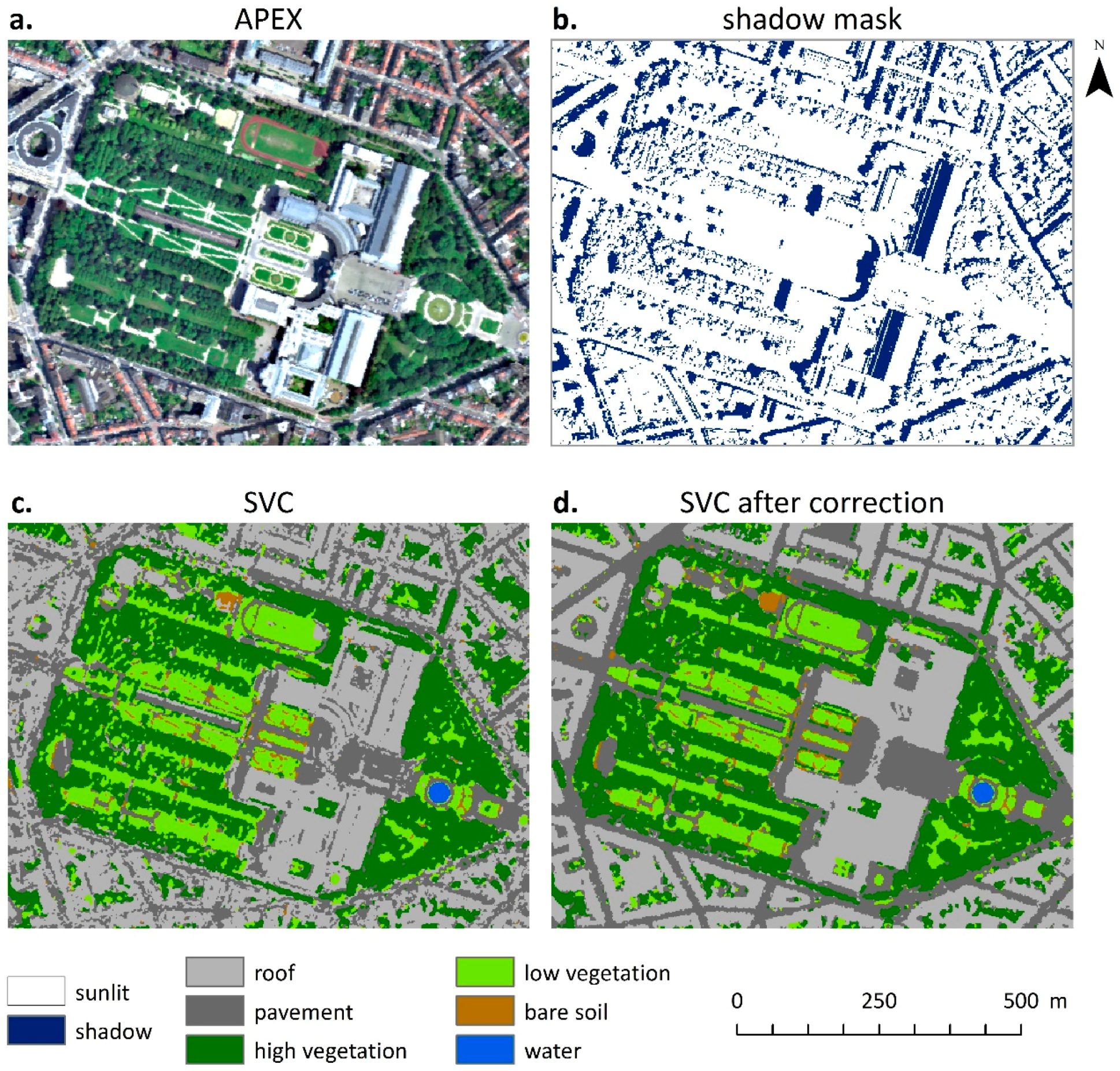
Source: Priem, F.; Canters, F. Synergistic Use of LiDAR and APEX Hyperspectral Data for High-Resolution Urban Land Cover Mapping. Remote Sens. 2016, 8, 787.
For applications in urban areas, elevation data can be used in a GIS to improve land cover maps. After all, it is very difficult to distinguish between certain types of roofing and ground cover using only spectral data.
In the figure above, a land cover map was created based on a hyperspectral APEX aerial image (a). The land cover map at the bottom left (b) only used spectral data, which means that roof surfaces, for example, are confused with streets and squares. Shadows (c) also cause problems. The map could be significantly improved using a height model derived from LiDAR data (d).