

IV - FROM DATA TO INFORMATION
1- PREPARE AN ANALYSIS (PRE-PROCESSING)
1.2- Geometric and topographic correction
Images obtained by Earth observation systems cannot be used directly as maps. Indeed, they are geometrically distorted by variations in height, orientation and speed of the satellite in its orbit, by the curvature of the Earth and its rotation during image capture, by perspective and the effects of relief, etc. These distortions are naturally amplified when the sensors on board the satellites take oblique images.
Some deformations, such as the effect of rotation of the earth or the effect of an oblique viewing angle, are predictable and therefore calculable so that corrections can be applied systematically. Satellites usually also have sophisticated on-board systems to record very small movements. This information is mainly used to correct the position of the satellite, but can also be used to partially improve the geometry of the images.
Image producers therefore usually propose to apply the most basic corrections already based on this known information.
To achieve higher geometric accuracy and to fit the images into a cartographic reference system, it is necessary to have spatial reference points. Such ground control points can be measured on terrain with GPS (GNSS) or possibly identified on a topographic map or from other cartographic reference material.
The procedure by which a recognised geographical coordinate system is assigned to an image is called georeferencing.
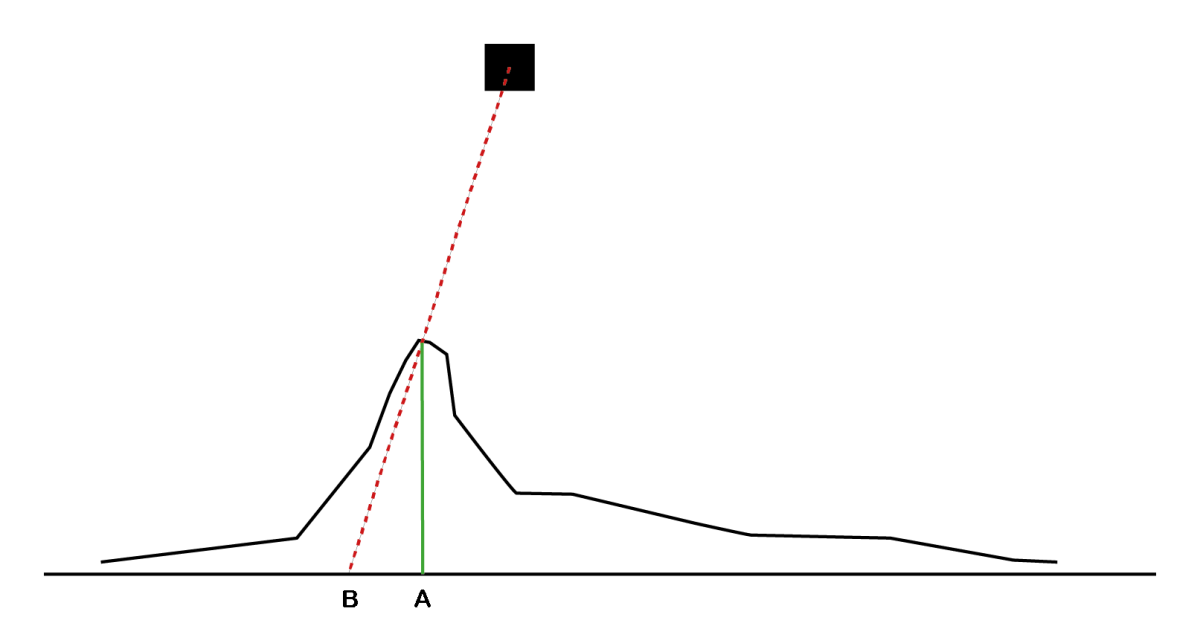
In areas with high relief, parallaxes caused by that relief are an important source of distortion, especially when images are captured with an oblique angle of incidence. On the figure, point A is the position of the top of the mountain on a map. Point B corresponds to the image of the top of the mountain as seen by the satellite. The distance A-B is the parallax generated by the relief.
On top of that, terrain also causes distortions, especially in areas with high relief differences. To extract the effects of perspective and to be able to interpret the image as a map, it has to be rectified in an orthographic projection. This correction for the height effect is called orthorectification. To achieve this, a digital terrain model (see 4.4.1) is needed, a computer file that represents the height of the terrain for each pixel of the image. Such models can be created in different ways, for example with LiDAR, radar or stereoscopic images.