

III - WHAT IS A DIGITAL IMAGE?
1- IMAGE OR DATA TYPES
1.3- Display of lidar data
If we mount a laser scanner under an aircraft, we obtain data showing the shape of the landscape as a detailed three-dimensional point cloud.
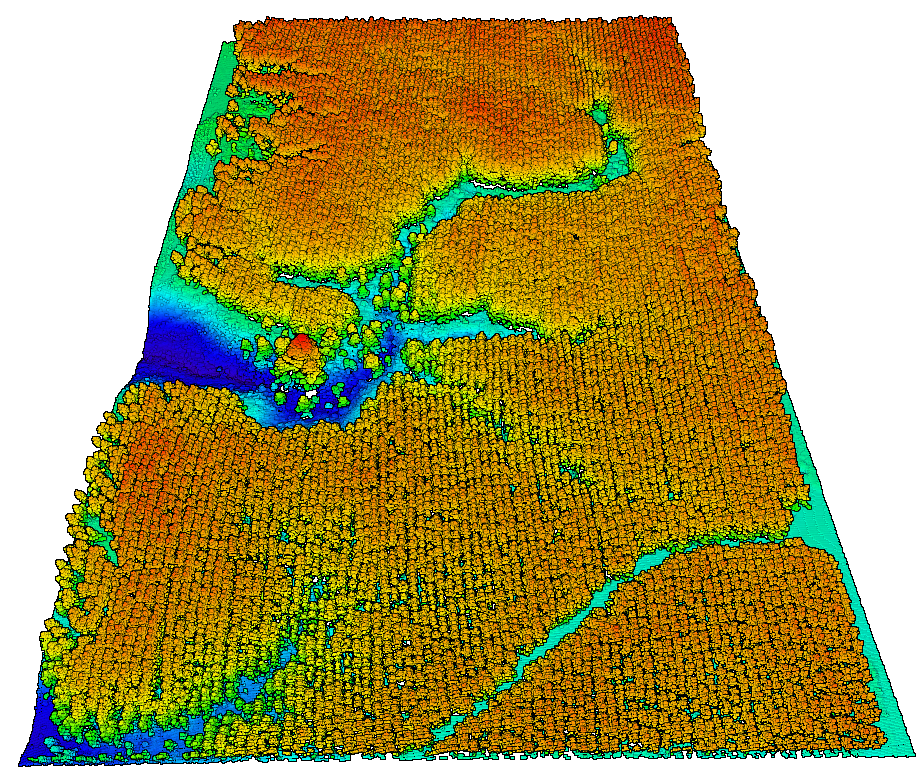
A lidar point cloud consists of millions of three-dimensional (x,y,z) data points. The above example contains an average of 6,10 points per square metre. In total, that makes a whopping 2,958,200,956 for this area. In the figure above, each point was coloured based on its height (z value). Source: LINZ (2019). Reporoa and Upper Piako River, Waikato, New Zealand 2019.
Each transmitted pulse can generate one or more echoes or reflections ("returns") in e.g. forested areas because the light pulses can get through the small open spaces of dense foliage. The first echo may therefore be received from leaves at the top of trees and vegetation, while the last measured return may only reflect the actual height of the ground surface. The reflections in between may then come from somewhere halfway (e.g. branches, understory vegetation, etc.).
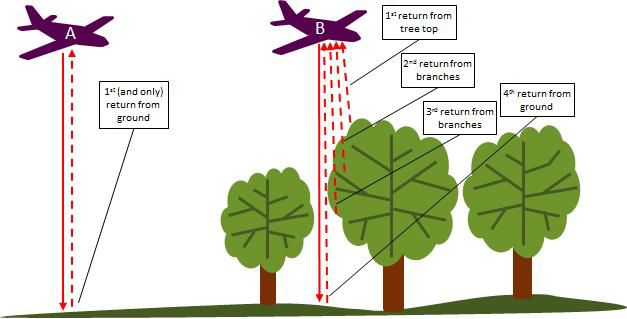
Basics of airborne LiDAR echoes in areas with (B) and without (A) vegetation. Source: Environment Agency Survey Open Data (2016).
Forest environments are one of the main application areas of lidar technology. Lidar data, for example, is now commonly used in archaeological research in Central America, as well as in other tropical regions. The identification and characterisation of archaeological remains plays a major role in such studies. Lidar recordings from aircraft are therefore increasingly being used for research and applications in archaeology, for example to study hard-to-access, densely forested areas where aerial photographs or satellite imagery are no help.
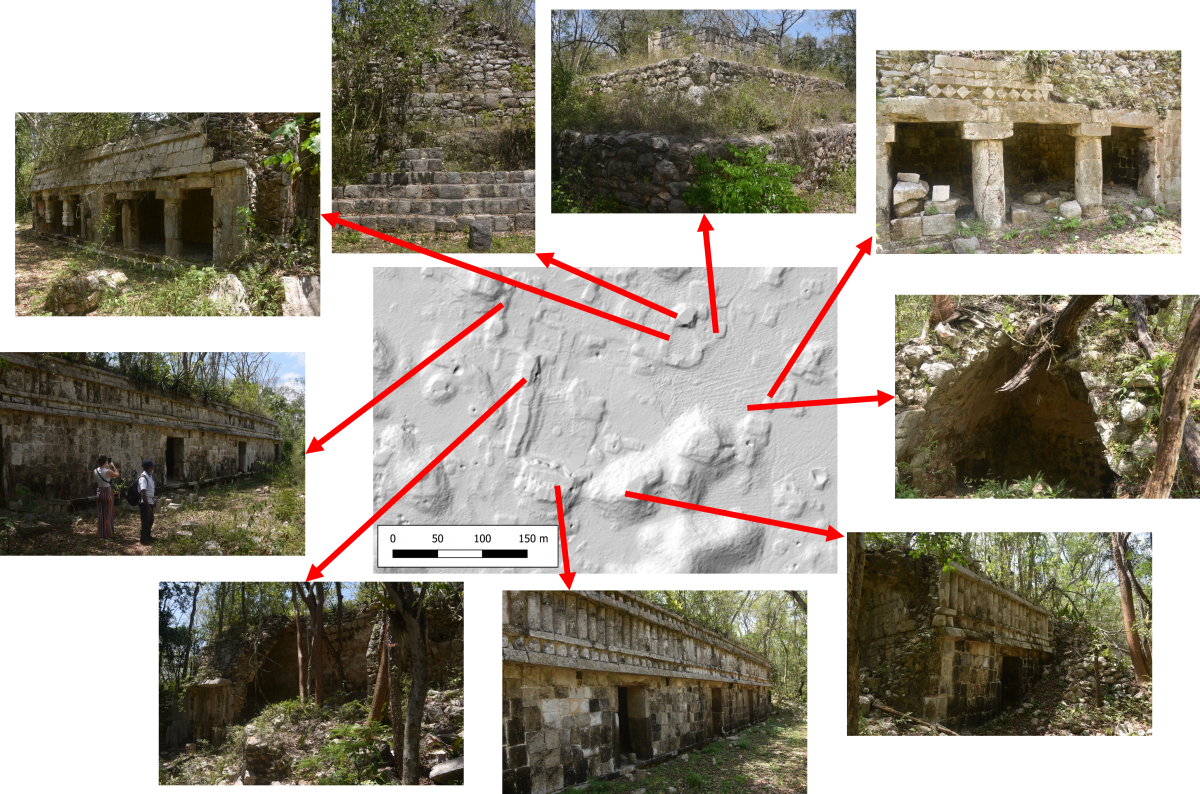
Maya remains in Yucatan, Mexico, clearly visible on the visualisation of an elevation model made from lidar aerial images.