

III - WHAT IS A DIGITAL IMAGE?
1- IMAGE OR DATA TYPES
1.2- Radar images
Unlike optical systems, which use elements such as lenses, mirrors or prisms, radar image acquisition is purely electronic. The radar consists of a transmitter, a receiver, an antenna and electronics for recording and processing. The antenna emits a series of short energy pulses of a specific wavelength in the microwave range. After interacting with objects on the earth's surface, part of the emitted energy reaches back to the antenna. This is the echo. As the platform continues to move in the meantime, a two-dimensional image is thus formed.
The time the pulses take to come back to the antenna allows to determine the distance to the target. Comparing the transmitted and received signals also provides a lot of information. For example, we can determine the backscatter coefficient based on the intensity of the received signal. This indicates the proportion of the emitted radiation that was scattered by the target and received back by the antenna. Comparing the transmitted and received signals also makes it possible to determine the phase shift. This is the fraction of wavelength observed between transmission and reception. The full intensity and phase characteristics of the return wavefront are recorded as if this wave arrived in the aperture of a lens or mirror.
The radar image itself is then reconstructed afterwards by mathematically simulating the effect of a lens on the received wavefront. This is called focusing. The result is an image for which we have two pieces of information at each point: amplitude and phase.

Ice displacement velocities on the King Baudouin ice shelf based on interferometry. Several techniques using SAR images can be used to map the displacements of ice surfaces and determine their velocities. One such technique is interferometry. Each pixel of a SAR image contains amplitude information, which relates to the reflectivity of the ground, and phase information, which relates to the distance between the satellite and the ground. An interferogram is obtained by subtracting the phase of two images taken at different times. A displacement will cause a phase shift in the interferogram. (See Satellite images over Antartica predict global climate change - STEREO project MIMO)
To this information, if the sensor allows, we can add polarisation. Most sensors today transmit in a linear polarisation and detect according to the same polarisation or according to a perpendicular polarisation. Therefore, if a sensor transmits in a vertical polarisation (V), it can "listen" according to a vertical (V) or horizontal (H) polarisation. The resulting image is qualified as VV or VH. Conversely, you can also get an HH or HV image. This makes it possible to observe other features of the scene. Indeed, an object will not react to a vertical polarisation in the same way as to a horizontal polarisation.
 |
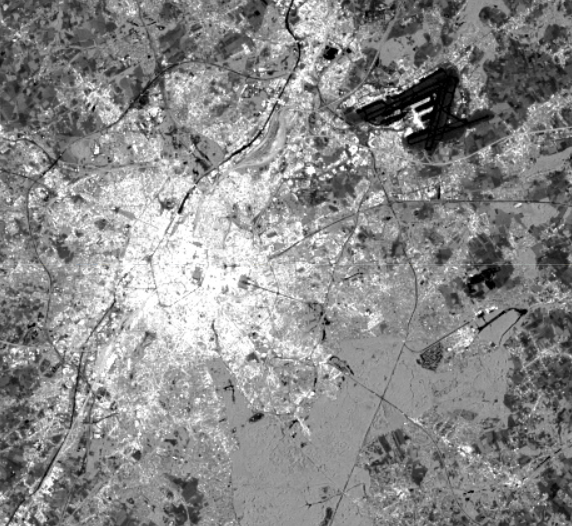 |
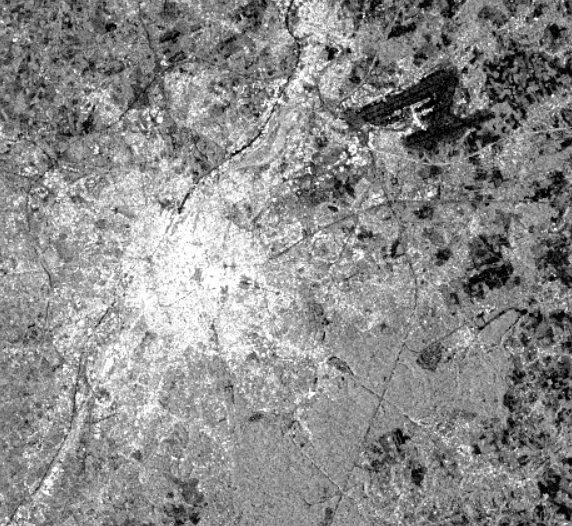
The image on the left is a Sentinel-1 image of Brussels recorded on 1/6/2018 with VH polarisation. The image on the right shows the median value per pixel of the backscatter values of all 2018 Sentinel-1 images recorded over this region.
A radar image looks like a greyscale image whose intensity represents the relative proportion of energy radiated back at a given location. This is the backscatter coefficient expressed in decibels. Its value depends on the objects on the ground (their nature, size, shapes and orientations), the moisture content of the area, the frequency and polarisation of the radar pulses and the angle of incidence of the radar beam.